

Charming hidden nooks off the tourist trail
Author: Krzysztof Mordyński, historian, curator at the Museum of Warsaw
Walking along Warsaw’s Royal Route, you can admire magnificent palaces, churches, and historic tenement houses. But sticking to this main thoroughfare means missing out on many unexpected places brimming with character: viewpoints, secluded courtyards, and hidden sculptures. Dare to leave the beaten track – explore an alternative route from Charles De Gaulle Roundabout (Rondo Gen. Charles’a De Gaulle’a) to Castle Square (Plac Zamkowy).
Look for the palm tree
Rondo De Gaulle’a, located at the intersection of Aleje Jerozolimskie and Nowy Świat, is one of the city’s busier and noisier places. Varsovians call it the “palm roundabout” because this exotic tree, though artificial, is more eye-catching than the monument to the famous French general and statesman. This palm tree is the ‘Greetings from Jerusalem Avenue’ installation by Joanna Rajkowska, which alludes to the historical name of the street, and its surprising presence in a Polish city is intended to prompt reflection on globalisation. However, global warming has made the sight of a palm tree less astonishing than it was in 2002, when the artist created the work.
The palm tree would certainly have shocked the original occupants of the former Communist Party Headquarters, a sizeable building set back slightly from the roundabout’s south-eastern side. The building was erected in 1948–1951 for the Central Committee of the Polish United Workers’ Party. Until 1989, the building hosted meetings of the Politburo, where the most important decisions were taken – apart, of course, from those that had already been made in Moscow.

Courtyard of the First Secretary
The Party Headquarters has quite a monotonous exterior with a large number of small windows stretching out in long, stacked rows, evoking the toil of bureaucratic work. But don’t let first impressions put you off. While the modernist architecture is stark from afar, closer inspection reveals charming details. Most tourists do not realise that the courtyard is worth seeing. It can be reached though wide passageways at ground level. Passing through the archway, you will see doors featuring meticulously crafted handles and protective grilles. In the courtyard, you are greeted by a fountain and the building’s concealed main entrance. The imposing triple portal and the balcony crowning it, decorated with a braided motif, are made of traditional Szydłowiec sandstone, while the floor is composed of grey granite and black marble. A decorative meander pattern runs around the fountain.
For half a century, this space was reserved for communist officials only. Meanwhile, the building’s architects – Wacław Kłyszewski, Jerzy Mokrzyński and Eugeniusz Wierzbicki – designed the archways on both sides of the courtyard so that the building could be passed through to the nearby Three Crosses Square (Plac Trzech Krzyży). However, this would have required demolishing the surviving early 20th-century tenement houses – which never happened.

Socialism versus capitalism
In 1990, the headquarters of the Communist Party was repurposed as – oh the irony of history! – the Stock Exchange, the ultimate symbol of the capitalist economy. However, the premises were deemed unsuitable, and in 2000, the Warsaw Stock Exchange relocated to a new building. You can reach it by leaving the courtyard through the southern passageway and taking the steps on the left. A subtle decorative element of the modern Stock Exchange building is inscriptions, numbers and stock market charts, hand-crafted and cast in aluminium, which architect Stanisław Fiszer intended to lend a human and personal dimension to architecture in the era of digitization and uniform façades.

In search of monsters and bogeymen
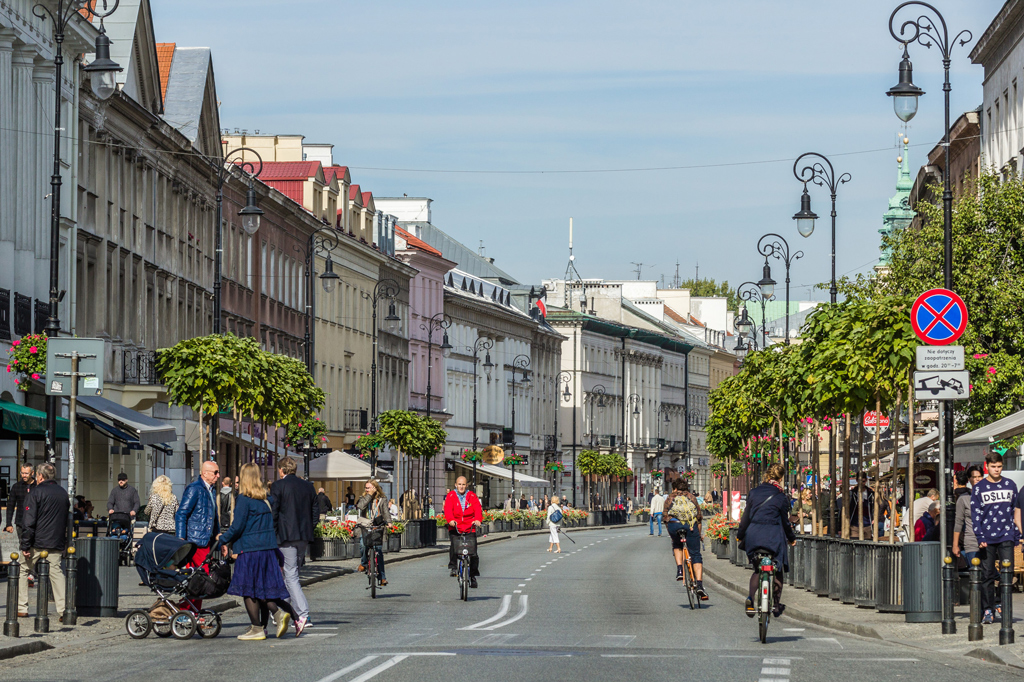
You can get back to Aleje Jerozolimskie via a secluded alleyway under the pergola. Passing the palm tree, you’ll briefly enter Nowy Świat Street, which runs in a slight arc towards the Old Town. Turn right onto Foksal Street. While Nowy Świat is dominated by rebuilt Neoclassical tenements, several buildings have survived around Foksal from the turn of the 19th and 20th centuries, representing a rich array of architectural styles. It is worth keeping an eye out for the façades’ sculptural details. The neo-Gothic tenement house at number 19 is guarded by fantastical winged creatures holding shields while monsters with gaping jaws lurk under its roof – gargoyles capping off the gutters. A more graceful touch is the ‘Allegory of the Vistula’ relief by Hipolit Marczewski, which depicts a woman and boys travelling in a boat. A different ambience is evoked by the Neo-Baroque tenement at 16 Foksal Street. Here, look out for sculptural details inspired by classical antiquity: the faces of bearded warriors, rams’ heads, and the horned Greek god Pan. At number 13, spare a moment’s sympathy for the figures of strong Atlantes holding up the balcony above the entrance, and gazing further up – find the faces hidden among the shells, like elves from fairytales and fantasy novels.
French accents in Warsaw
Foksal Street leads to Zamoyski Palace, which ends the sightseeing axis. Around 1875, architect Leonard Marconi designed this intimate but elegant residence for Count Konstanty Zamoyski, drawing on the style of the late-French Renaissance. An attractive play of colours and textures is created by small orange bricks, rusticated horizontal bands and sculptural elements, as well as the tall, slender chimneys piercing the sloping mansard roof. The palace is currently the headquarters of the Association of Polish Architects.
After seeing the palace, look for a rather mysterious passage to its rear, a pathway hidden on the right side of the entrance. It leads to the edge of the Vistula escarpment and a path running along ornate wrought-iron railings. From here you can enjoy views of the monastery gardens located below, the Powiśle district, and the other bank of the Vistula River, dominated by the National Stadium. The orchards and cultivated plots at the foot of the slope belong to the Congregation of the Daughters of Charity, commonly known in Poland as the Grey Sisters – not because of the colour of their habits, but due to the French word charité, meaning charity, which sounds like the Polish word for grey. The sisters were granted this prime piece of land in the heart of the city in the 17th century from Queen Louise Marie Gonzaga. Turning left to head north, you can look down on the convent and its characteristic ridge turret – a small bell tower perched above the roof. Among the buildings is also a former 17th-century granary with small rectangular windows.

Heading north, you will come to the Fryderyk Chopin University of Music and the Ostrogski Palace, where the Chopin Museum is located. This is among Warsaw’s main tourist attractions. Between the university and the museum runs Ordynacka Street, which will take you back to Nowy Świat. Cross Nowy Świat and duck into Warecka Street on the other side. It leads to a passage through a gateway, beyond which a surprise awaits.

Where do Winnie the Pooh and Piglet go for walks?
Lovers of A. A. Milne’s work will immediately respond that Christopher Robin’s friends stroll through Hundred Acre Wood. In Warsaw, they have one more place they like to visit. This is Winnie the Pooh Street (ul. Kubusia Puchatka). It links Warecka and Świętokrzyska streets, framing views of the Ministry of Finance and the tower that serves as the symbol of the Nowy Świat West estate. The complex of houses, shops and social institutions was designed in 1949–1956 by a group of architects led by Zygmunt Stępiński. It is not only the name of the street that is unusual, but also the fact that talented designers gave the housing estate a cheerful appearance, despite the buildings being erected during the period of socialist realism and the Stalinist dictatorship.

The cluster of houses resembles a small 18th-century town. In front of the building with the tower is a green square, a quiet spot to relax, leading to Tuwima Street, flanked on both sides by vaulted arcades. It is worth paying attention to the tower, on which Hanna Żuławska created sgraffito images of the sun and moon, as well as decorated friezes under the cornice featuring animal figures. These decorations are a reference to the purpose of the building’s ground floor, where a kindergarten is located.
Winnie the Pooh Street’s name was chosen in a public vote organised in 1954 by the Express Wieczorny daily paper. At each end of the street are plaster reliefs depicting distinctive images of the honey-loving bear and his friend Piglet. If you walk down the street to Świętokrzyska and turn right, then left, there are some famous landmarks: the Copernicus monument, Staszic Palace, and Holy Cross Curch.

A modern sculpture and a hidden rider from another era
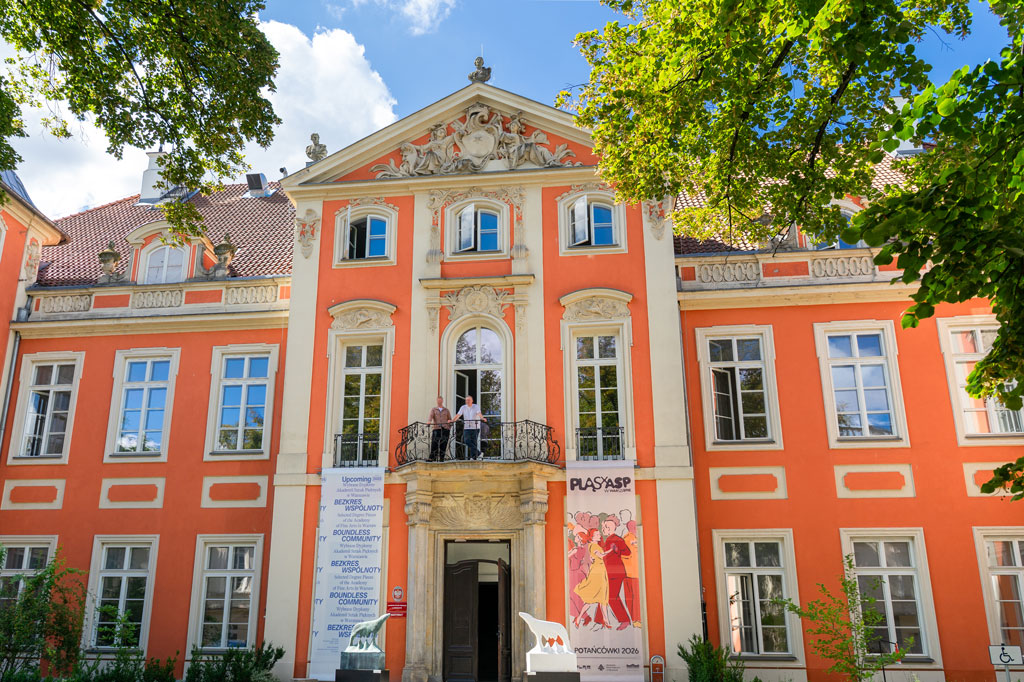
Once past the church and across Traugutta Street, grand ornamental gates open up ahead on both sides of Krakowskie Przedmieście. The one on the right leads to the University of Warsaw, and the one on the left to the Academy of Fine Arts. Head through the latter, between the faculties of Graphic Arts and Painting, and you’ll come to the façade of the late-Baroque Czapski Palace. Along the way, you will see an outdoor exhibition displaying works by Warsaw students. At the end of the path, tucked slightly away to the left, stands an imposing equestrian statue that will be familiar to lovers of art history. It is a replica of a monument to Bartolomeo Colleoni – one of the most celebrated sculptures of the Renaissance.
The original was created in 1496 by Andrea del Verrocchio to commemorate the formidable condottiero – the commander-in-chief of the Venetian Republic’s mercenary forces. The original monument stands on a tall plinth in Venice’s Campo Santi Giovanni e Paolo (Saints John and Paul Square), while its Warsaw copy can be studied up close, as it was intentionally placed at eye-level. Colleoni’s stern, menacing glare is immediately eye-catching, as are the realistically crafted details of his armour, the equestrian trappings, and the stallion’s sinewy silhouette, but one element may come as a surprise: the horse’s brightly painted genitals. This is not a crude act of vandalism, but rather a traditional way for students to diffuse the solemnity of a centuries-old masterpiece exhibited alongside contemporary works.
The replica of the Colleoni monument has a turbulent history. Before World War II, it was in the City Museum in the coastal city of Szczecin, which was then still within the borders of Germany. After the war, the city became part of Poland, and in 1948 the monument was relocated to Warsaw – a city devastated by the German occupation and stripped of its artwork. The monument served as a model for students, becoming an integral part of the university’s tradition and image. However, the people of Szczecin campaigned for the monument’s return, which took place in 2002. Colleoni was placed in pride of place on Szczecin’s Aviators’ Square (Plac Lotników), while the one on display in Warsaw is a bronze copy of the earlier replica.
The long and winding road
Heading further north, towards the Old Town, you will pass by the baroque Visitationist Church on the right. Behind the monument to Cardinal Stefan Wyszyński, a diagonal alleyway leads to a monument to a lower-ranking priest, but one with a huge heart and gifted with poetic talent. Father Jan Twardowski had a knack for explaining complex matters in simple language and was constantly amazed by the beauty of the world – his statue invites you to share a bench with him and a spend a moment listening to recordings of his works.
Continuing the walk in the same direction and turning right above Karowa Street, you will pass the secluded garden of the convent of the Visitation Sisters, where Father Twardowski lived. The small cottage-style houses here contrast with the grand city tenements on the other side of Karowa Street. But this is the essence of the final stop on our walk.

Karowa Street takes its name from kary – horse-drawn carts that used to haul waste out of the city. It was once very steep, which caused great difficulties for the horses pulling the carts. To solve this problem, in 1905, the impressive Stanisław Markiewicz Viaduct was built, lengthening the route through a series of sweeping curves to lessen the road’s steep gradient. You can reach it by walking down the street.
It is an elegant piece of engineering in the Art Nouveau style. Two gently spanned arches stretching over the roads below reflect architect Stefan Szyller’s longing to create an equally beautiful bridge over the Vistula. The Markiewicz Viaduct is adorned with Art Nouveau streetlamps mounted on obelisks, and sculptures by Jan Woydyga. The most recognisable is a mermaid with a sabre, the emblem of Warsaw. The capital is also symbolised by a sculpture of a woman with a crown shaped like city walls, while a mustachioed man with a cog depicts labour and industry. In the early 20th century, the view from here looked out over the industrial Powiśle district with its power plant, gasworks and other factories. Today, the buildings of the University of Warsaw can be viewed from the viaduct.
Visiting this handful of places can enrich a walk along Warsaw’s main tourist attraction – the Royal Route. Monuments, scenic viewpoints, hidden courtyards, sculptures, and fine architectural details lie just off the route, but are easily missed if you do not know where to look. So we invite you to discover them while exploring the city.

For more tips on how to visit Warsaw sign up for our newsletter and stay up to date!
* By clicking the ‘Subscribe’ button you consent to receiving the newsletter from us and accept the Regulations of the ‘Newsletter’ service. We will process your e-mail address for the purpose of sending you the newsletter. The administrator of your personal data is the Warsaw Tourism Office. More information on the privacy policy and cookies policy and clause concerning the processing of personal data.