I love Warsaw in spring as it gradually awakens from its winter dormancy. Every day, as the temperature rises, the city acquires energy—seasonal events begin, new attractions appear, and the streets are filled with people out walking. It’s the perfect time to discover Warsaw in full bloom!
The Vistula—the heart of Warsaw and a fashionable district
It is difficult to imagine Warsaw without the Vistula—the river has been crucial for the development of the city for centuries. These days its banks are teeming with life, especially in spring, when the boulevards become an ideal place for walking, cycling, or sitting back with a coffee. Before the summer season begins and crowds descend on the boulevards, it is worth taking advantage of the tranquillity of spring and discovering the charms of the city in an intimate atmosphere.
Panorama of Warsaw, photo: Cezary Warś, City of Warsaw
Take a walk along the boulevards and the pedestrian and cycle bridge
Strolling along the boulevards by the Vistula, you can reach a new pedestrian and bicycle footbridge connecting the two banks of the river, which in March this year will celebrate its first birthday. It is 452 metres long and has an interesting, modern design. It is the longest crossing of its kind in Poland and one of the biggest in Europe. In addition to its practical function, the footbridge offers stunning views of the Warsaw panorama. This is one of my favourite spots to recommend to tourists—especially at sunset, when the light gives the city a magical charm. In fine weather you can take beautiful photos from here. One winter Sunday, I took some Italian tourists to the footbridge at sunset. Although Italians do not like the cold, the sight of the sun setting over the city made them forget about the chilly weather. Their only reaction was a big “Wow!” and despite the frost, they did not want to move on.
Pedestrian and bicycle footbridge over the Vistula River, photo: Łukasz Kopeć
Elektrownia Powiśle (Powiśle Power Plant) — a modern take on industrial history
The Powiśle district adjacent to the Vistula River is one of the trendiest parts of Warsaw. It combines picturesque boulevards with atmospheric streets and modern investments. It is a place where history meets modernity, and Varsovians and tourists alike enjoy the unique ambience of this part of the city. While in Powiśle, I recommend visiting the Powiśle Power Plant (Elektrownia Powiśle) — an extraordinary example of the revitalisation of an industrial building. For almost a century, it supplied electricity to the city’s inhabitants and today it is a vibrant centre combining boutique shops, trendy restaurants, spas and cultural spaces. If you visit at the weekend, it is worth checking whether one of its numerous events is being held—for example, vintage or craft fairs.
Elektrownia Powiśle, photo: City of Warsaw
Easter in Warsaw—traditions and customs
Is it worth visiting Warsaw during Easter? Of course! However, it should be remembered that on Easter Sunday the museums are closed, though on Monday some of them reopen their doors to visitors. But there is more to Warsaw than museums—the city’s festive atmosphere also has a unique charm of its own.
Easter Palms, photo: Filip Kwiatkowski
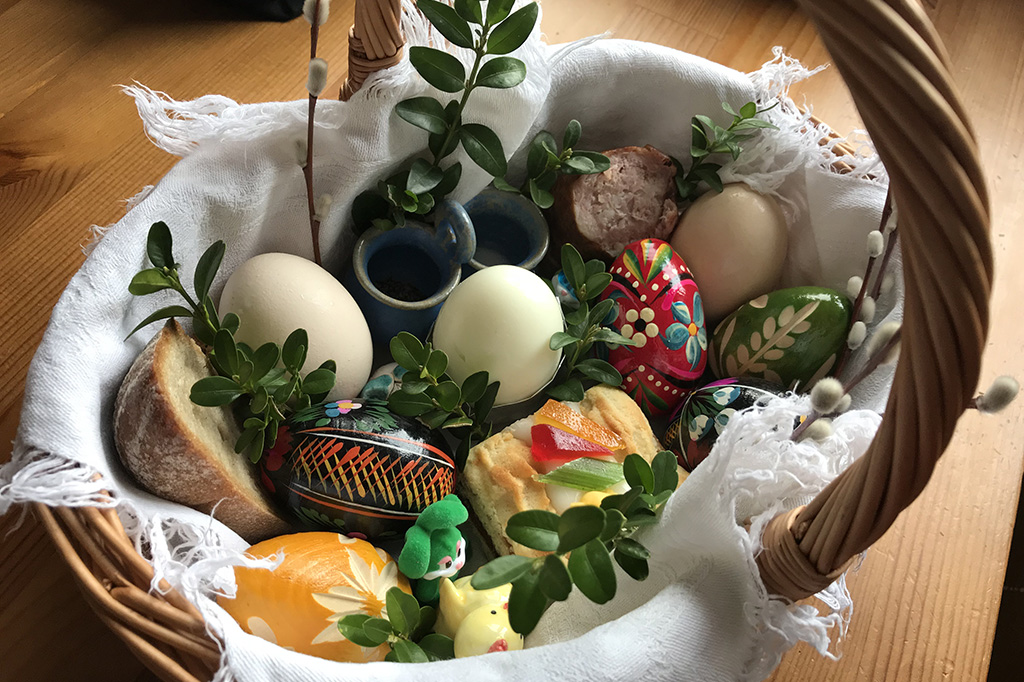
Holy Saturday and the tradition of blessing baskets of food, the so-called "Święconka"
One of the most interesting Polish Easter customs is the blessing of food on Holy Saturday. It is a tradition with a long history, dating back to pagan times when people made offerings to thank nature for its gifts. This custom has survived to this day and is cultivated in a unique way in Poland. The custom is to have various food items blessed that will later be eaten during the Easter breakfast. Traditional foods placed in baskets include eggs, sausage, ham, bread, and salt, as well as sweet pastries. It is worth visiting the Old Town to witness this custom for yourself. Weather permitting, outside churches tables are set up on which Varsovians place their baskets. This is a unique moment that attracts the attention of tourists—my Italian guests are delighted by the sight as there is no such tradition in Italy. On a pre-Easter walk, you can also visit Easter markets where local artisans present handicrafts, and stalls tempt you with traditional delicacies.
Easter basket, photo: Iwona Gmyrek
Easter Monday—museums and family attractions
On Easter Monday, many museums are open to visitors. For example, art lovers can visit the National Museum, which has a collection of over 800,000 works—from old masters to contemporary art. However, if you want to spend time with your family in the open air, it is worth visiting Warsaw ZOO. This attraction has existed for almost a hundred years and keeps many species of animals. Among them is Fredek the tortoise—one of the zoo’s oldest inhabitants and a member of one of the world’s most endangered species.
National Museum, photo: City of Warsaw
Wet Monday—or ‘Śmigus-dyngus’—a tradition that lives on
Walking around Warsaw on Easter Monday, you may come across groups of young people (and not only!) pouring water on each other. If you accidentally get soaked—take it as part of the tradition! Wet Monday is also a custom with pagan roots—water symbolised purification and the rebirth of nature in the spring. In the past, pouring water was also a way of… expressing feelings! Bachelors doused the girls they liked, believing it would bring them health, beauty, and a fair complexion. Today, it is primarily a fun pastime that still brings much joy—especially to children and adolescents.
Panorama of Warsaw, photo: City of Warsaw
May Day long weekend, or 'majówka'
Early May is a time full of attractions in Warsaw: concerts, picnics, cultural events and shows. The reason is not only the spring weather, but also the fact that both May 1 and May 3 are public holidays.
Zamkowy Square, photo: Cezary Warś, City of Warsaw
The anniversary of the Constitution of May 3
Exactly 234 years ago, on May 3, 1791, the Constitution of May 3 was adopted in Warsaw—the first in Europe and second in the world, after the Constitution of the United States. The document was signed at the Royal Castle in Warsaw during the reign of the last king of Poland, Stanisław August. Many ceremonial events are held to mark this anniversary, including colourful military parades, historical reconstructions, and educational events. It is a great opportunity to get better acquainted with Polish history and tradition.
Royal Castle in Warsaw, photo: City of Warsaw
May Day at Royal Łazienki
One of the key venues for May Day celebrations is Royal Łazienki, the summer residence of King Stanisław August. It features historic gardens of almost 80 hectares, which is twice the size of the Vatican. In the heart of the park is the Palace on the Isle—a pearl of neoclassical architecture where you can admire the royal collection of paintings. Meanwhile, the Old Orangery houses the Royal Theatre—one of the few surviving 18th-century court theatres in Europe. During the May Day long weekend, you can visit the Palace on the Isle, meet characters dressed in historical costumes and participate in numerous events, such as open-air concerts or theatre performances.
Royal Łazienki, Palace on the Isle, photo: Filip Kwiatkowski
1 May—anniversary of Poland's accession to the European Union
May 1 is not only International Workers’ Day, but also the anniversary of Poland’s accession to the European Union in 2004. On this date, numerous events are organised every year, including concerts by artists from across Europe, street theatre performances, and outdoor festivals. One of the centres of these celebrations is Krakowskie Przedmieście—one of Warsaw’s hallmark streets. For three days, it transforms into a vibrant promenade full of attractions, performances and shows. The Warsaw May Day is a great opportunity to combine open-air leisure with discovery of the city’s history and culture, whether you prefer festive celebrations, concerts, or tranquil strolls in parks.
Krakowskie Przedmieście, photo: Łukasz Kopeć
Where to find information?
Since there are many so events, and schedules can change, it is worth visiting the Tourist Information Centre, located in the Palace of Culture and Science. There you will get up-to-date information about events, museum opening hours and public transport info, as well as free maps and city guides.
Author: Brian Bonini, Warsaw guide
Tourist Information Centre in the Palace of Culture and Science, photo: Maciej Deperas
For more tips on how to visit Warsaw sign up for our newsletter and stay up to date!