

Warsaw at the Expo 2025 Osaka
Warsaw, the capital of Poland, located in Central Europe, is a dynamically developing metropolis where history blends with modernity. Three royal residences delight visitors with their interior décor, and the Old Town, which appears on the UNESCO World Heritage List, attracts tourists from the world over with its ambience. Did you know that two exceptional figures spent their childhood and youth here: Fryderyk Chopin and Maria Skłodowska-Curie? You can still find traces of their presence in many places. It is hard to believe, but the Vistula River, which flows through the middle of the city, features a natural forest-lined bank where wild birds nest. In the city centre, among the skyscrapers, stands Varso Tower – the tallest building in the European Union. And the local culinary scene is as rich and diverse as the city itself. Find out for yourself by visiting the capital of Poland.

Warsaw’s Old Town charms visitors with its colourful tenement houses and the unique atmosphere of its narrow streets.
It was built on the site of a medieval princely settlement, which over time became the seat of Polish kings. Totally destroyed during World War II, it was completely rebuilt, and its painstaking reconstruction and the uniqueness of the project were appreciated by UNESCO, which included it on the World Heritage List.
The central point of the Old Town is the Market Square, laid out at the turn of the 13th and 14th centuries, in which stands a monument to a half-fish half-woman. She is the Warsaw Mermaid—the city’s patroness, who also features on Warsaw’s coat of arms.
You can learn more about the history of the city and its inhabitants at the Museum of Warsaw.
In the Archcathedral, see the graves of medieval Mazovian princes and the last king of Poland, Stanisław II August.
Be sure to also visit the Royal Castle, where the Constitution of 3 May was adopted—the first in Europe and second in the world. In addition to the royal apartments, you will also see paintings by Rembrandt. The column standing in front of the castle depicts King Sigismund III Vasa, who moved the Polish capital to Warsaw.
In summer, the Old Town teems with life thanks to its numerous alfresco cafés, and in winter its fairy-tale illuminations are delightful.

They all come from different historical eras, and each of their histories is related to a particular Polish ruler.
The Royal Castle, located on the site of a former ducal stronghold, was the first seat of Polish monarchs in Warsaw. It was expanded by King Sigismund III Vasa, who in 1596 moved the capital of Poland to Warsaw from Kraków. The castle is famous for its sumptuous apartments and an art collection including two works by one of Europe’s greatest artists—Rembrandt. It was here that the first European Constitution was adopted, on 3 May 1791.
The Royal Łazienki was the summer residence of the last king of Poland, Stanisław II August. The Polish name for the extensive parklands—Łazienki—is derived from a small palace standing on an island in the middle of the lake, which was originally a bathhouse. King Stanisław hosted artists and scholars there at weekly ‘Thursday Dinners’. From spring to late autumn, when the parklands are full of flowers, you will come across strolling peacocks and frolicking squirrels.
Meanwhile, the Palace of King Jan III at Wilanów is a work of the Baroque era. Its first occupant won renown for his valour and victory at the Battle of Vienna in 1683, protecting Europe from invasion by the Turks. The ruler lived here with his beloved wife, Marysieńka. While visiting the royal apartments, you will see a collection of almost 1,000 paintings, which has been open to public viewing since the beginning of the 19th century. In spring, magnolias bloom in front of the palace, and in winter the whole area is lit up by spectacular illuminations.
Fryderyk Chopin spent his childhood and youth in Warsaw. It was here that he composed his first works, performed in public for the first time at the age of eight, and later gave numerous concerts in the salons of the aristocracy.
Today, just like two hundred years ago, his unique music still rings out in many places in the capital of Poland. You will get to know about the life and work of the composer in detail at the Fryderyk Chopin Museum. Among the exhibits you will see there, are the Pleyel piano he played for the last two years of his life, and a cast of his hand.
An unusual attraction is hidden in the Basilica of the Holy Cross. In a pillar of this church lies the composer’s heart, brought from Paris to Warsaw by his sister Ludwika, who thus fulfilled her brother’s final will.
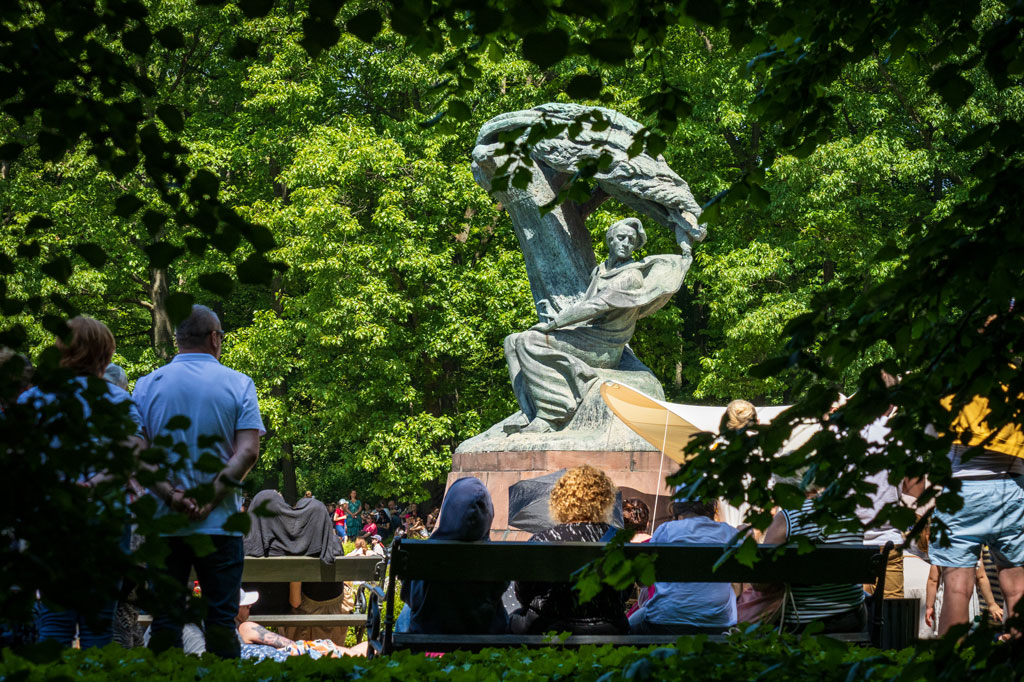
An iconic statue of the artist sitting under a willow tree is located in the beautiful gardens of Royal Łazienki Garden. Every Sunday from May to September, you can listen to the famous free recitals held continuously since 1959.
In the Visitationist Church on the Royal Route you will see the organ played by the young Fryderyk, and near sites associated with the artist you will come across multimedia benches. Each of them, when the button is pressed, plays a short piece of the composer’s work.
Every day, at many intimate venues, you can listen to live recitals of the artist’s music.
Every five years, Warsaw hosts the International Chopin Competition—one of the most prestigious events in the piano world. The next, 19th, edition starts on October 2 this year.

Warsaw is the birthplace of Maria Skłodowska-Curie and the city where she spent her childhood, went to school, and discovered her scientific vocation.
Start your tour at the museum dedicated to the Nobel Prize winner, located in the tenement house where she was born. Among the things to see here are several of Maria’s preserved personal items, such as her last desk, numerous photographs from various stages of her life, video clips and correspondence, as well as laboratory measuring instruments.
Maria was baptized in the nearby Church of the Visitation of the Blessed Virgin Mary, located on the edge of the escarpment.
This area was also where the future two-time Nobel Prize winner used to take walks. Today, there is a view of the Multimedia Fountain Park, the Vistula River, and the right-bank part of the city, which Maria still admires from the statue that stands here.
Following in the scientist’s footsteps, enter the café of one of Warsaw’s most famous hotels—the Bristol. Here in the Raspberry Room (Sala Malinowa), a banquet was held in the scientist’s honour for being awarded her second Nobel Prize—for chemistry.
The interiors of the Warsaw University of Technology building are a must-see for all, not just lovers of historic architecture. In addition to the magnificaent vaulted ceiling, you will find a sculpture of the scholar here—another reminder of her presence in Warsaw in 1925.

Approximately a quarter of Warsaw’s surface area is covered by greenery in various forms. Nature lovers can spend time in one of the historic gardens at royal residences, in secluded parks, roof-gardens, or even natural forests in the city centre and on the outskirts of the metropolis.
Royal Łazienki Garden, the Gardens of the Palace at Wilanów, the smaller but no less charming Gardens of the Royal Castle, or the Krasiński Garden will not only relax you but also delight you with their sophisticated architecture and art.
Interesting examples of sculpture woven into park landscapes also await you in Skaryszewski Park and Bródnowski Park with their open-air galleries of modern art.
A varied range of thousands of plants from the world over can be enjoyed in two botanical gardens. In addition to aesthetics, they provide a large dose of knowledge.
The Garden on the roof of the University Library creates a harmonious whole with the building and is worthy of the moniker ‘masterpiece of landscape architecture’.
One of Warsaw’s unique attractions is the Vistula River, which flows through the city centre. Its natural, wild shore overgrown with forests is a sanctuary for waterfowl. If you want to get some exercise in the bosom of nature, you can take a walk along the path running through it, or go to Bielański Forest where some of the trees are several hundred years old.
Those interested in the reconstruction of Warsaw after World War II can walk around Operation ‘Tempest’ Park, which surrounds the Warsaw Uprising Mound.
All these places become particularly picturesque in autumn, when Warsaw’s parks blossom in a feast of colour, imbuing the city with a unique charm.

Modern Warsaw
Did you know that Warsaw is one of the most dynamically developing European metropolises and a regional centre of innovation?
This facet of the city is evident in its architecture, which changes from year to year. In the city centre, where the 1950s Palace of Culture and Science with its famous viewing platform once reigned supreme, you can admire the futuristic silhouettes of skyscrapers. Among them, Varso Tower stands out, towering more than 300 meters in height with its spire—currently the tallest building in the European Union. On the roofs of some buildings, like the Hub or Varso, there are luxurious cocktail bars. How about a drink overlooking the Warsaw skyline?
Modern office blocks were the envy of Warsaw’s museums and other cultural and scientific buildings. The popular Copernicus Science Centre—which will transport you to the world at the end of the 21st century—has recently been joined by several new buildings with monumental structures. In the heart of the city, on Central Square, stands the snow-white building of the Museum of Modern Art, which is a must-visit for every self-respecting connoisseur of this type of creativity. In another part of the city, on the grounds of a 19th-century fortress, two new attractions have recently been developed side by side: the Polish History Museum, recognised in the Prix Versailles competition as one of the most beautiful museums in the world, and the Polish Army Museum, coloured to match the brick walls of the fortress.
Meanwhile, innovation is born at the Google Campus, situated in the premises of the former Koneser Vodka Factory, and at events that draw not only Warsaw startups.

Warsaw’s culinary scene is as diverse as the city itself.
The dishes of traditional Warsaw cuisine owe their flavours to the influence of various cultures and nationalities. You can sample them at many plush restaurants in the Old Town. Try traditional dishes, such as Warsaw-style herring, jellied pig’s trotters (nóżki w galarecie), sour rye soup (żurek), borscht, tripe soup, or Warsaw-style potato dumplings (pyzy).
You should also try local sweet treats—’wuzetka‘ cakes, doughnuts, and Wedel hot chocolate.
On many restaurant menus you will see dishes from various parts of the world. The widest selection of designer restaurants serving international cuisine can be found in the historic interiors of former factories and market halls: Elektrownia Powiśle (the Powiśle Power Plant), Hala Koszyki (Koszyki Hall), Praga Koneser Centre, Browary Warszawskie (Warsaw Brewery) or Fabryka Norblina (Norblin Factory).
Meanwhile, establishments recommended by the international Michelin guide await the most demanding gourmets.
Vegetarians and vegans will also love Warsaw—few cities in Europe have so many vegan restaurants.
If you are curious as to how Varsovians dine alfresco, visit the weekend breakfast fair or the Night Market—a Mecca of international street food at a former railway station.
To learn about the history of two Warsaw specialities, visit the Polish Vodka Museum and the Wedel Chocolate Factory.

Warsaw souvenirs
Their connections with the city, its culture, residents and cuisine will remind you of Warsaw when you return home. Small souvenirs can be found in many shops in the Old Town.
However, it is worth taking the trouble to buy unique items that you will not find anywhere else. Visit the shops at the Museum of Warsaw, the Chopin Museum or the Maria Skłodowska-Curie Museum. Only in this last attraction can you buy a book of the famous letters between the double Nobel Prize winner and Albert Einstein, showing the extraordinary relationship between the two scientists.
Warsaw’s culinary specialties make an equally good choice: chocolate products from the Wedel Factory, which has existed since 1851, sold in the company’s chocolate-drinking lounges, or traditional Polish tipples from the Polish Vodka Museum store.
Or maybe you will be tempted by a jar of honey from the Warsaw apiaries or artistic ceramics from one of Warsaw’s studios? Handmade plates, bowls, cups and vases are delightful in their diversity. Thanks to these items, your memories of Warsaw will live on forever.

Lorem ipsum dolor sit amet, consectetur adipiscing elit, sed do eiusmod tempor incididunt ut labore et dolore magna aliqua. Ut enim ad minim veniam, quis nostrud exercitation ullamco laboris nisi ut aliquip ex ea commodo consequat. Duis aute irure dolor in reprehenderit in voluptate velit esse cillum dolore eu fugiat nulla pariatur. Excepteur sint occaecat cupidatat non proident, sunt in culpa qui officia deserunt mollit anim id est laborum.