

Warsaw is awash with greenery
Warsaw is one of Europe’s greenest capitals. It is easy here to combine exploring the city, its culture, monuments and history with walks among trees, bushes and flowers. It is up to individuals themselves to decide whether they prefer an elegant palace garden, a park with picturesque landscapes, or maybe a secluded urban forest or green hideaway on the site of an old fort. I invite you to discover Warsaw not as a bustling metropolis but as a green and soothing city.
A sophisticated stroll in Royal Łazienki Park
Royal Łazienki is one of the city centre’s most beautiful historic gardens. The name comes from a 17th-century garden pavilion with a bathhouse, but today it is primarily a spot for walks, concerts, cultural events, and encounters with history. The Royal Łazienki owes its present look to King Stanisław August, who at the end of the 18th century rebuilt the garden pavilion into the charming Palace on the Isle and erected an amphitheater, an orangery, and other buildings that are now open to the public. In the centuries that followed, the palace and gardens were enriched with new pavilions, monuments, and greenery. Today, walks in Royal Łazienki Park offer magnificent views along the lake and the chance to enjoy different types of gardens: from 18th-century royal to 19th century romantic and 20th-century modernist. Royal Łazienki’s location on the Vistula escarpment makes it a place of particular beauty, and among the lush greenery a variety of wildlife can be seen, including peacocks, swans, woodpeckers, foxes, hedgehogs, and squirrels. But be careful! Anyone who disrespects the gardens’ royal majesty will promptly be invited by the guards to leave: in the Royal Łazienki, it is forbidden to ride bicycles or scooters, bring in dogs or cats (even on a lead), or feed the local fauna.

If you're with kids, you have to visit Ujazdowski Park
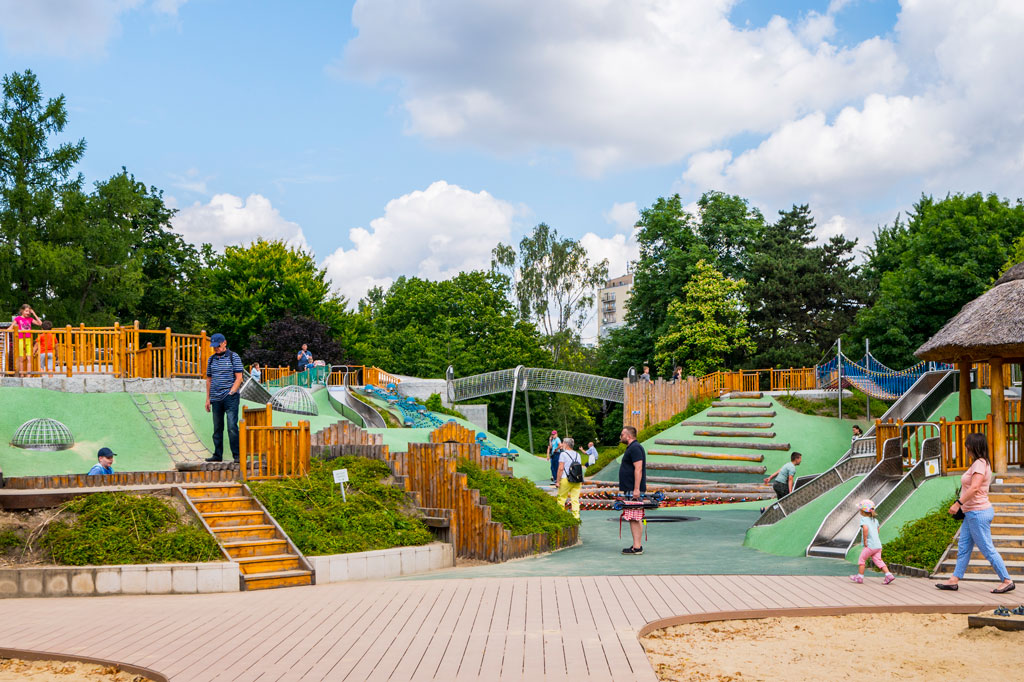
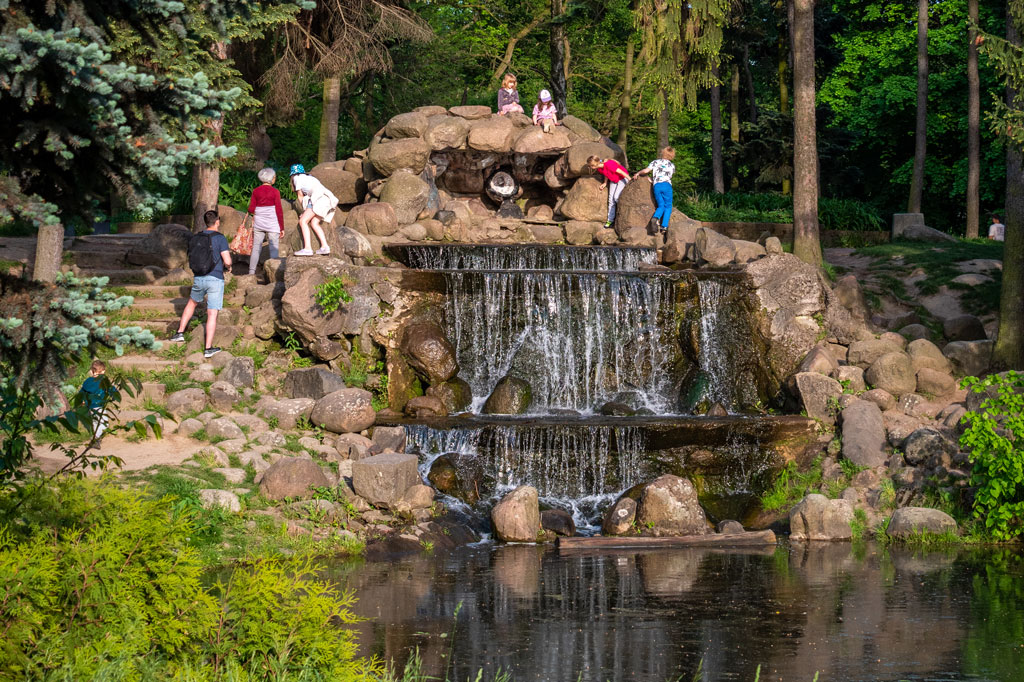
Not far from the Royal Łazienki on Aleje Ujazdowskie is the smaller, but very well-kept, Ujazdowski Park. In the 19th century, there was a field here for military exercises, public feasts, and industrial exhibitions. In the closing years of the 19th century, Franciszek Szanior designed a calligraphic park at the site. The fluid lines of the walkways, lawn boundaries, and pond banks referenced the art of calligraphy and shapes drawn with a compass. This imbued the park with a gentle, serene mood, perfect for unwinding and relieving stress. The grounds are divided into two areas. The southern section features a romantic landscape with a pond fed by a stream flowing from the rocks. An arched bridge was built over the stream, creating a perfect setting for lovers to meet. The park’s northern part is renowned for its sculptures, including Ewa (Eve), a modernist work by Edward Wittig, and Pius Weloński’s Gladiator. For younger visitors, there is also an extensive play area in the form of an artificial hill featuring slides, climbing frames, and all sorts of surprises.
Long-distance escarpment hike with great views
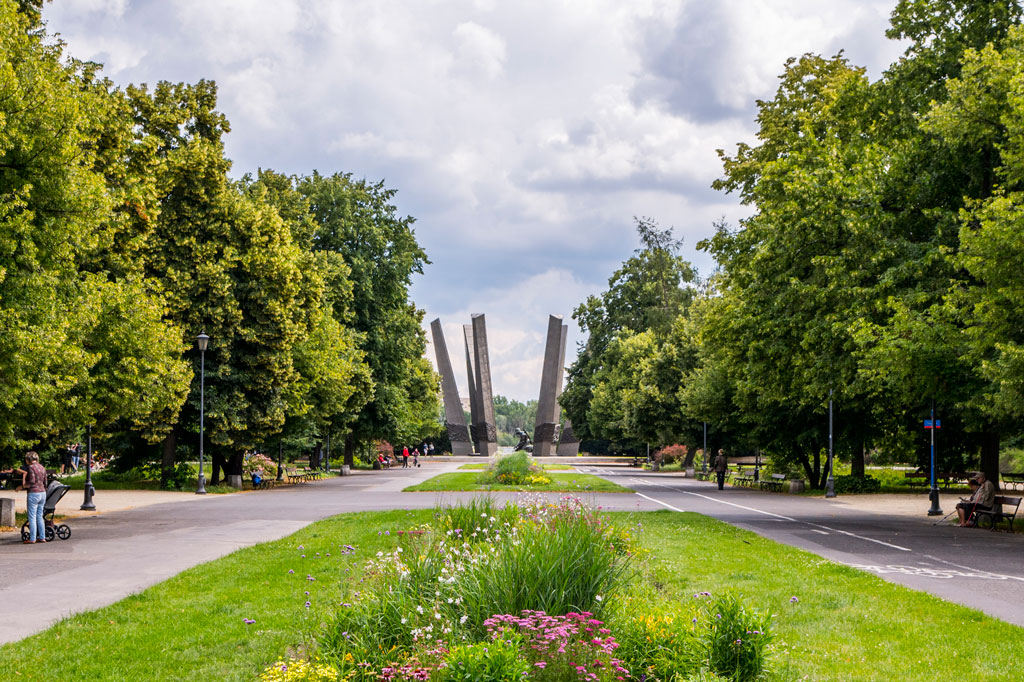
Walkers looking for longer trails in the city centre can opt for a picturesque route running along the escarpment. It starts at Ujazdowski Castle, a former residence of kings from the 17th-century Vasa dynasty which today houses the Centre for Contemporary Art. The building’s eastern façade overlooks the steep bank of the slope, affording breathtaking views along the Piaseczyński Canal towards the Vistula River. The Vistula, which once flowed beneath the escarpment itself, changed course and left a strip of land occupied today by gardens and the Powiśle district. Walking along the edge of the escarpment to the north, you will come to a place where the river runs very close to the slope. A scenic route of several kilometres leads through five parks (T. Mazowiecki, E. Rydza-Śmigły, Na Książęcem, K. Beyer, Kazimierzowski) and across four footbridges gracefully spanning the streets below (Al. Armii Ludowej, Górnośląskiej, Książęca, Tamka). The greenery-lined pathway leads behind the Polish Parliament and passes a viewpoint looking out over a kilometer-long axis crowned by the Sapper Monument. The route leads past the modernist Powiśle train station, the University of Music, the Chopin Museum, and the University of Warsaw, ending at the historic Markiewicz Viaduct.
The roof of the University Library
A modern library building of the University of Warsaw was built at the base of the escarpment on Dobra Street, not far from Krakowskie Przedmieście. On its northern side is a small park that literally climbs up the side of the building and covers its roof. It is worth visiting this place to seek out the pond at the bottom of the park, and then play explorer by following the stream up to the roof of the library. The 360-degree panoramic view stretches out over the greenery of the Vistula River’s wild right bank − home to many species of birds and a vibrant beach life − the Old Town, the former Powiśle Power Plant, and the modern city of Warsaw with its skyscrapers. The curious can also look for a large round window hidden in a pergola, through which you can peer into the library and see students studying in the reading room.

Baroque sculptures in the Saxon Garden (Ogród Saski)
Warsaw’s first park, opened to the public in 1727, is also a reminder of the spectacular 18th century palace and garden estate of Kings August II and August III, known as the Saxon Axis. The park is fan-shaped and cut through from east to west by the main avenue. Here you will find Warsaw’s most famous fountain, shaped like a large chalice with water gushing from the mouths of dragons. The rushing sound of the water is so strong that it drowns out noise from the street. The park’s attractions include flower parterres and walkways winding through the greenery, as well as a pond and a water reservoir imitating the Temple of Vesta in Tivoli. It was built along with the fountain in the mid-19th century, when Warsaw’s first extensive water supply system was constructed. Along the main avenue, the oldest remnants of the Saxon era can be seen − sculptures from the original garden representing the seasons, virtues, vices, and professions. The most important structure, standing on the boundary of the park and Piłsudski Square, is the Tomb of the Unknown Soldier, housed in old ruins − arcades from the former Saxon Palace, destroyed by the German occupiers in 1944. Preparations are currently underway to rebuild the palace, and cellars dating back the 18th–20th centuries have been unearthed around it.

Flowers and treasures of the National Library in the Krasiński Garden
The garden was created at the Baroque Krasiński Palace, designed in the 17th century by Dutch architect Tylman van Gameren for the wealthy Krasiński family. In 1768, after the property was bought by the state, the garden was made available to the public, and the building became the Palace of the Republic of Poland. The park is small, but can certainly be considered a gem of landscaping thanks to its impeccable greenery, thoughtful layout, and numerous highlights. There are sun loungers in the recreational area on the Świętojerska Street side, while closer to the garden’s centre are a water playground, boule courts, and tables for board games. There is an outdoor gym for lovers of open-air workouts and three children’s playgrounds, designed for different age groups. Why not combine leisure time in the garden with a visit to the Palace of the Republic of Poland, which is free to enter. Not only are the Baroque interiors worth seeing, but so are the treasures of the National Library, which acts as the palace’s custodian.

Art and sport in the landscaped Skaryszewski Park
On the right bank of the Vistula, near the National Stadium, is the entrance to Skaryszewski Park. In the 19th century, this area was given over to extensive urban pastures. In 1916, a large landscaped park was opened here, designed by Franciszek Szanior and featuring a series of distinct areas, each evoking a different mood. The charming rose garden is a must, as are the spruce-forested hillock, the Kosek pond, and the open shores of Kamionkowskie Lake. Don’t be surprised if you run into groups of young women picnicking on blankets in this romantic setting, as it is a popular place to kick off hen nights.
Famous sculptures of the interwar period were incorporated into the park’s landscape: Stanisław Jackowski’s Tancerka (Dancer, 1927), Henryk Kuna’s Rhythm (1929) and The Bather by Olga Niewska (1929). Those who enjoy active leisure time can make use of the free kayaks avilable on Kamionkowskie Lake. Why not also head to the other side of the lake, where the famous E. Wedel factory is located, to visit the Chocolate Lounges boutique in the historic, early 19th-century toll house?
And for the more adventurous…
For those who don’t mind venturing beyond the very heart of the city, attractions await in Warsaw’s farther afield but easily accessible districts. The Mokotów district is home to the Królikarnia Palace, perched on the escarpment and housing the Museum of Sculpture. Just visiting the park surrounding the palace is like viewing an outdoor gallery, and you can continue your walk into Arkadia Park, which runs down the slope to the ponds below. It is from here that the palace’s dome-topped silhouette shows its most graceful face. From the centre, a short tram or bus ride whisks passengers to Wilanów − once the suburban palace of King Jan III Sobieski, the saviour of Vienna (1683). The palace and garden complex in Wilanów is the capital’s most beautiful example of a royal Baroque residence (admission fee applies). Alternatively, lovers of fortifications should head to the northern Żoliborz district and the Stefan Żeromski Park at Wilson Square (Plac Wilsona on the M1 metro line). The park was built around the Fort Sokolnickiego, which dates back to 1851 and was one of the defensive structures surrounding the Warsaw Citadel. The fort’s most interesting feature − the artillery tower − has survived and today houses the Fort Sokolnickiego Cultural Centre. Heading further east brings you to the Moat Park and Citadel Slopes (Park Fosa i Stoki Cytadeli) − a name that perfectly sums up this verdant open space. The Żoliborz Gate (Brama Żoliborska) leads into the Citadel, which is home the Polish History Museum and Polish Army Museum. But if you would rather run or walk in the forest, take the M1 metro line to Kabaty station. Kabaty is also the name of a forest just half a kilometer away, which has cycle paths, educational routes, and hiking trails.
Author: Krzysztof Mordyński, historian, researcher of the history of Warsaw

For more tips on how to visit Warsaw sign up for our newsletter and stay up to date!
* By clicking the ‘Subscribe’ button you consent to receiving the newsletter from us and accept the Regulations of the ‘Newsletter’ service. We will process your e-mail address for the purpose of sending you the newsletter. The administrator of your personal data is the Warsaw Tourism Office. More information on the privacy policy and cookies policy and clause concerning the processing of personal data.