Go To WarsawWarsaw is soaring! The capital’s tallest buildings and their incredible stories from the Middle Ages to the present day
Warsaw is soaring!
The capital's tallest buildings and their incredible stories from the Middle Ages to the present day
If you want to see the tallest skyscraper in the European Union, take a walk around Warsaw. Varso Tower’s spire seems to touch the sky with its tip reaching a height of 310 metres! However, before the office block claimed the title, the capital of Poland was reigned over by the neighboring Palace of Culture and Science, its peak shrouded in clouds on overcast days. Tall Gothic structures had already been built in the Old Town, and then even taller ones were erected, serving a range of functions: defence, prayer, measurement, communication, culture, entertainment, work, and housing. The latest skyscrapers are impressive not only for their height, but also for their aesthetics, technology, eco-friendly approach, and observation decks.
The Warsaw skyline
If you want to take in the whole of Warsaw at once, the most interesting views are from bridges or the new pedestrian and bicycle crossing over the Vistula at the end of Karowa Street. During Warsaw’s reconstruction after World War II, great care was taken to ensure the city had a harmonious panorama. The view from the right bank of the Vistula River unfolds in layers: greenery climbing up the riverside escarpment, low-rise historic palace buildings, the red roofs of tenement houses and higher church towers, and only then—further behind them—downtown Warsaw with its high-rise buildings. Initially, the monumental Palace of Culture and Science dominated the city alone, but in the 21st century it was set against modern, steel-and-glass skyscrapers. Most of the tall buildings are located close to each other, creating a massif that marks the very city centre.
Panorama of Warsaw, photo: Łukasz Kopeć
Above the Old Town
From the Middle Ages, the city was dominated by the towers of churches and the city walls. The view of the imposing silhouette of the city’s principle church (today the Cathedral of St. John) filled the hearts of old Warsaw’s townsfolk with pride. Today, the cathedral’s steep roof, its peak towering 50 metres, continues to dominate the Old Town. Until the early 17th century, an impressive tower, the tallest in the city, still soared above the church. Unfortunately, a violent gale that swept through Warsaw in 1602 caused part of the tower to collapse and the rest was dismantled, never to be rebuilt.
Old Town, photo: Cezary Warś
Climbing the spiral staircase of Marszałkowska Tower
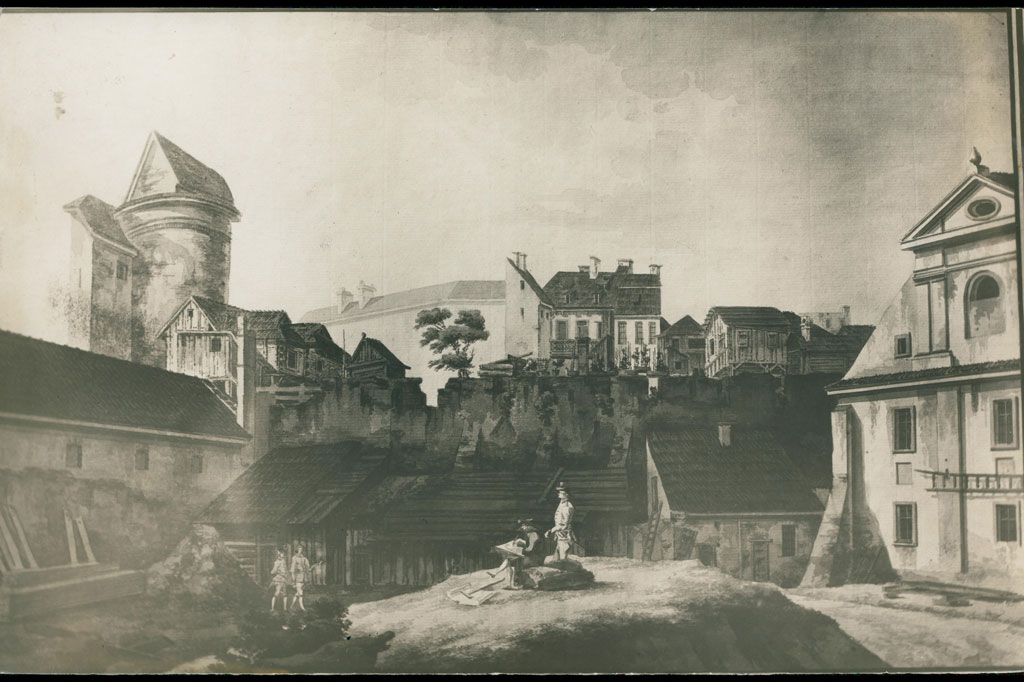
The double line of fortifications surrounding the city was reinforce with gates, bastions and towers, the highest of which stood at the northeastern end of the Old Town. The 25-metre-high Marszałkowska Tower dates back to 1379. From its arrow slits, it was possible to command the eastern view over the exit of Mostowa Street that led to seasonal crossings over the Vistula River. The appearance of the lofty, high-roofed tower was captured by Zygmunt Vogel at the end of the 18th century, shortly before it was dismantled in 1808. After World War II, its foundations were discovered and a spiral staircase was built into them, which serves tourists and pedestrians as an entrance to the Old Town from the side of the Multimedia Fountain Park.
Photograph of a watercolor by Zygmunt Vogel from 1785 titled "View of the Marshal's Tower and the walls of old Warsaw", photo from the collection of the National Library polona.pl
Cross of merit for the water supply network
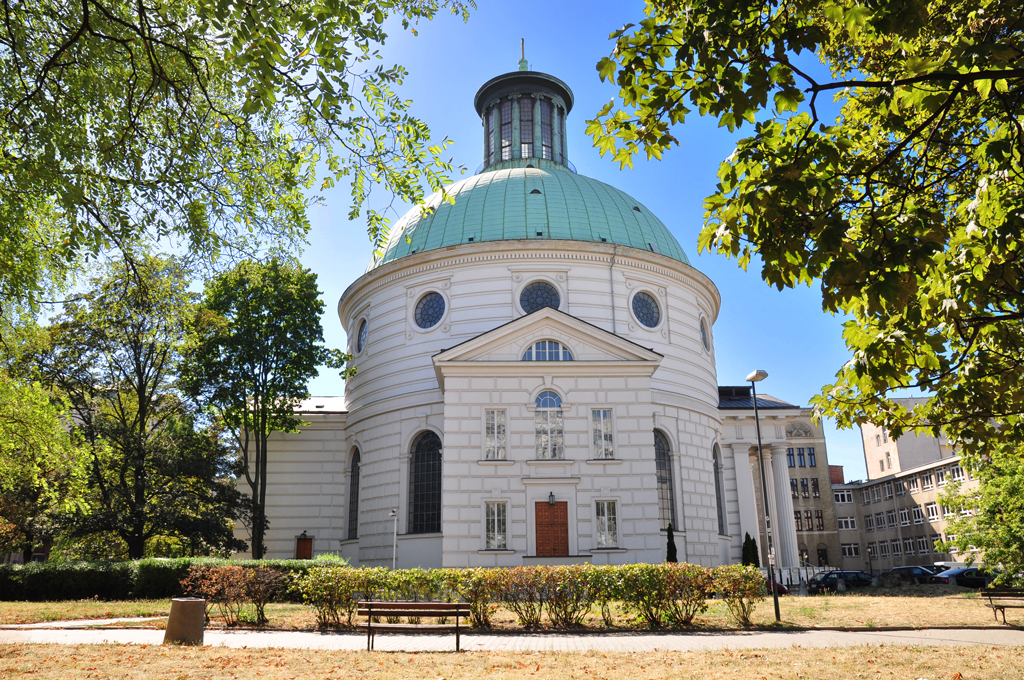
In the 18th and 19th centuries, the city’s tallest building was the Evangelical Church of the Holy Trinity on Małachowski Square. The house of worship, completed in 1781, was given a monumental, early-Neoclassical form that still makes a striking impression today. Its dominant structure takes the form of a cylinder crowned by a magnificent dome with a lofty ‘lantern’—a lightweight structure with large windows. Curious and tenacious travellers were drawn to this vantage point in the 19th century, climbing up to admire the view of Warsaw, while artists and photographers came to capture its panorama—a full 360 degrees to every point of the compass! The lantern is topped by a golden cross placed at a height of 58 metres. At the end of the 19th century, British engineers from the pioneering Lindley family used it as a triangulation point to develop a network of water supply and sewage systems. Today, the building still serves as a house of worship, but is also renowned for its classical music concerts.
Evangelical Lutheran Church of the Holy Trinity, photo: Łukasz Kopeć
Sky-high telephonists
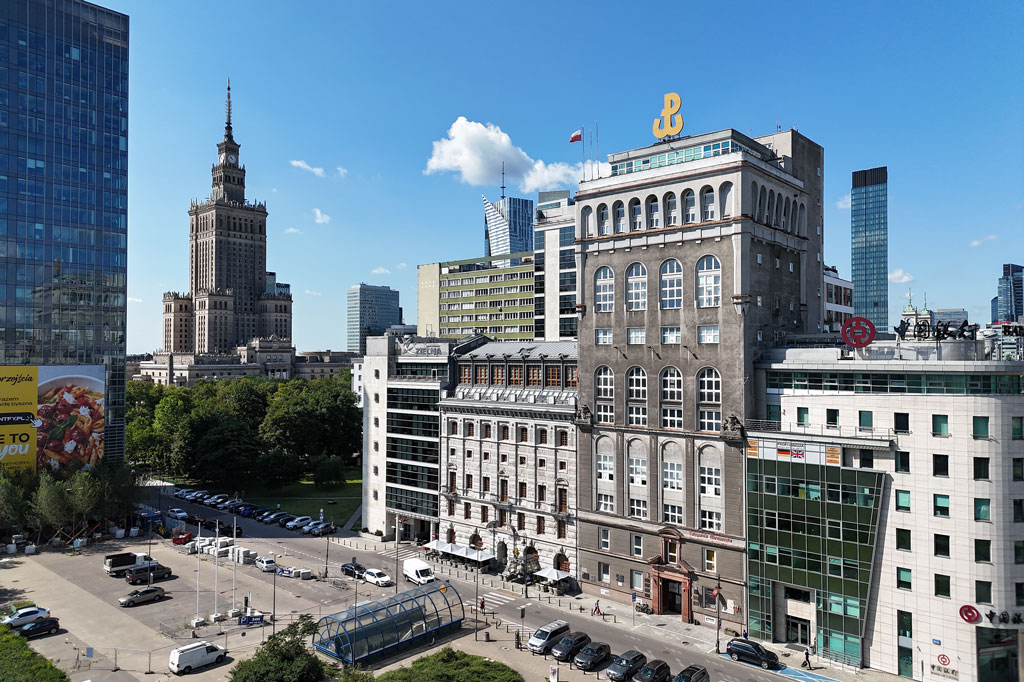
At the end of the 19th century, Warsaw started developing a telephone network. Demand for the invention was so high that in 1904–1910, Swedish company Cedergren erected two buildings at 37 and 39 Zielna Street for a new telephone exchange. In line with the aesthetic preferences of the time, the taller building’s ultra-modern reinforced concrete structure was masked by pseudo-medieval architecture resembling a massive tower with arcades, corbels and crenellations. For a year, the structure was the tallest commercial building in Europe at 51.5 metres, before it was overtaken by Liverpool’s Royal Liver Building in 1911. In 1922, the edifice became the property of the Polish Joint Stock Telephone Company; its acronym, PAST, has served as the building’s name ever since. In its upper part, high windows surrounded a sky-high pillared hall where telephone operators worked, known as the ‘girls from the tower’. The building was severely damaged in fighting during the Warsaw Uprising, when it was stormed by Polish insurgents. After the war, ‘Pasta’ was renovated, but sadly stripped of its picturesque crenellations.
PAST Building, photo: Łukasz Kopeć
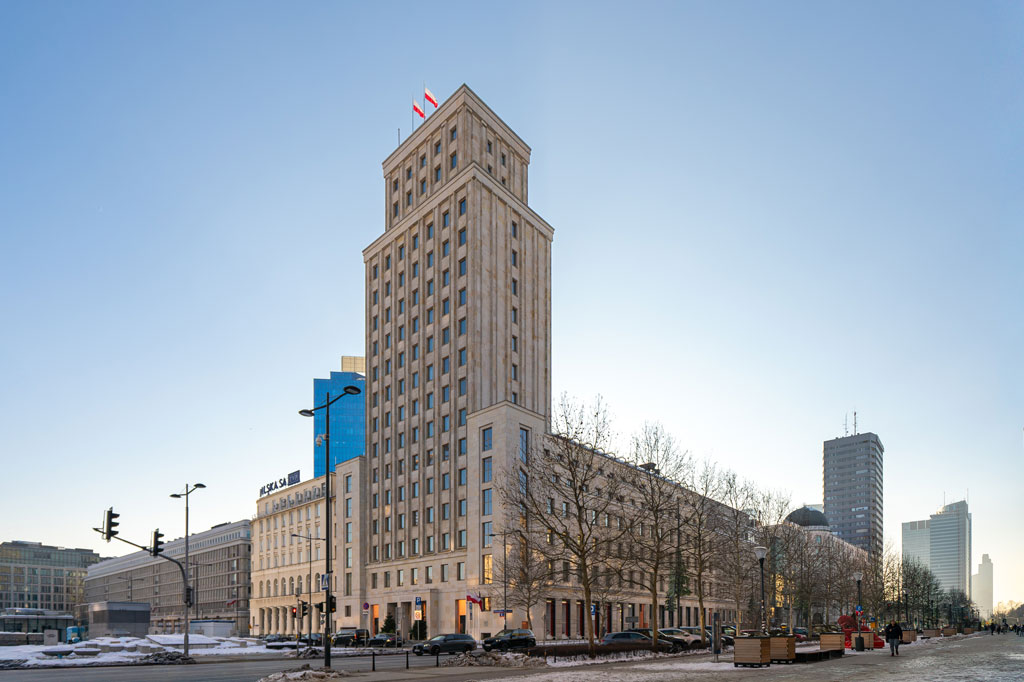
The indomitable Prudential (today the Hotel Warszawa)
In 1933, construction of the Prudential, the tallest office block in pre-war Warsaw, was completed on Napoleon Square. Its understated, economical form stood 66 metres high and housed 16 floors. The tower was built by the Prudential insurance company, but it was not the offices on its lower floors that were the building’s main allure, but rather the luxury residential apartments within the tower itself. They spanned as much as 240m2 in area and offered a great view of the capital. Occupied by insurgents during the Warsaw Uprising, the building became a primary target of German artillery attacks and an iconic photo of a huge plume of smoke rising from the Prudential after a strike by a two-ton shell remains one of the resistance campaign’s most enduring images. Designed by Stefan Bryła, the Prudential’s steel structure was so strong that it withstood about 1,000 strikes by various shells. After the war, the skyscraper was renovated and became home to the Hotel Warszawa.
Prudential, photo: Maciej Deperas
The Palace of Culture and Science—the capital's tallest historic building
After the war, Polish architects planned to build a cluster of modernist skyscrapers in the centre of Warsaw, but for political reasons their plans had to be set aside for the construction of the Palace of Culture and Science. Officially presented as a “gift from the USSR”, it was seen more as a symbol of Soviet domination, and its Stalinist architecture provoked great controversy. The building was completed in 1955, and together with its spire it stood over 230 metres high, making it the second tallest building in Europe (until 1990). The palace occupied a huge area in the city centre, and around it the vast expanse of Defilad (Parade) Square stretched out. Its spacious interior housed theatres, cinemas, museums, banqueting halls, the Great Congress Hall, and the Youth Palace, as well as offices. Its main attraction, which draws domestic visitors and foreign tourists like a magnet, is the chance of heading up to the 30th floor. After the 1989 fall of communism, the building’s demolition was considered, but the plans were abandoned and now the palace stands as a heritage site. The building is protected not only by security guards, but also by animals: a colony of cats lives in the basement to keep pests at bay, an apiary on the roof of one wing supports the urban ecosystem, and a nest of peregrine falcons beneath the spire scares off pigeons. You can watch the falcons live on the website.
Palace of Culture and Science, photo: Cezary Warś, m.st. Warszawa
Where will the U.S. President stay?
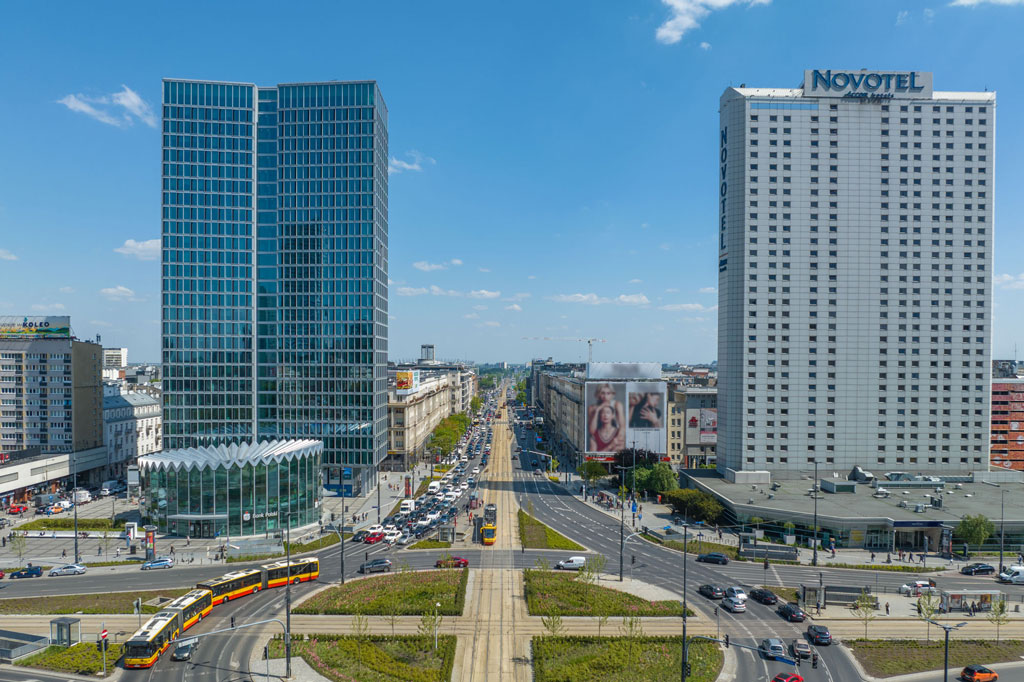
Initially, the Palace of Culture had no competition, but from the late 1960s, ever higher modern buildings started being built in its vicinity. In 1969, on the opposite side of Plac Defilad, the Eastern Wall was completed—a complex of department stores with the pedestrianised ‘Wiecha Passage’ behind, inspired by Rotterdam’s famous Lijnbaan shopping precinct. Making up part of the complex are three 24-storey residential towers that rise above the passage to a height of 80 metres. Not far away, a Swedish company built the Hotel Forum in 1974 (now the Novotel), which shocked Varsovians with its monolithic slab-like bulk seemingly perforated by six hundred small windows. Initially, only foreigners were allowed to use the hotel, and the cost of a stay was accepted only in dollars, possession of which was forbidden to Poles under communist rule. In 1976, the hotel hosted legendary supergroup ABBA.
Dmowski Roundabout, Jerozolimskie Avenue, photo: Cezary Warś, m.st. Warszawa
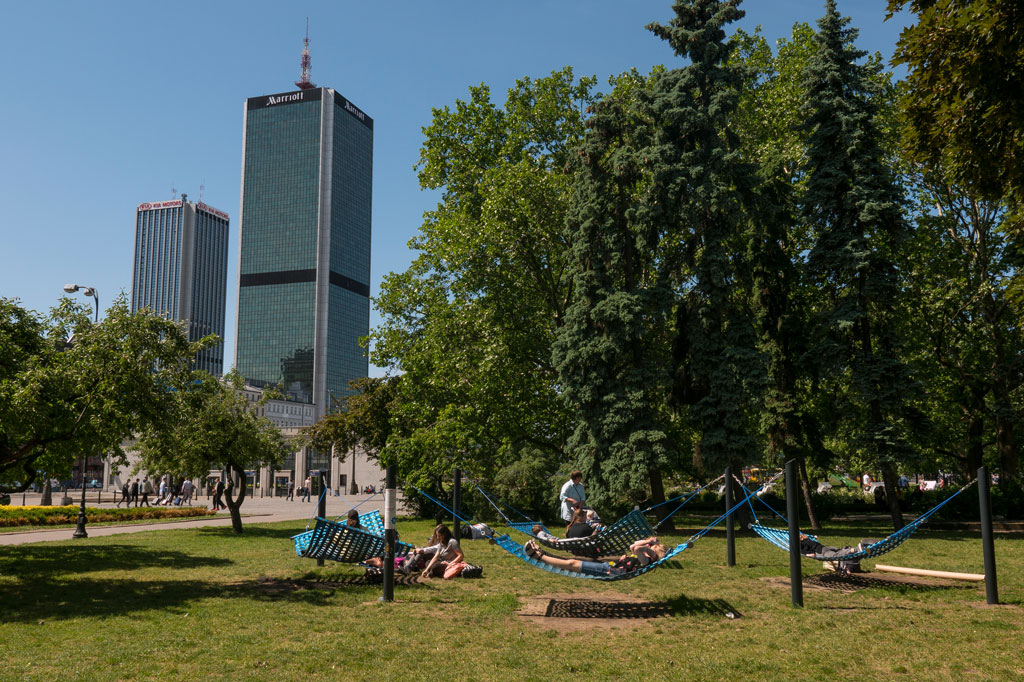
On the other side of the palace, a Western Wall was planned, but only two skyscrapers were built, known as the Marriott (now the LIM Center) and Elektrim (today Ch8). The two buildings formed an aesthetic and functional ensemble, were similar in appearance, and their first floors were connected by a system of walkways and footbridges, which created an elevated gallery with offices, shops and restaurants above street level. The former Marriott hotel was favoured by U.S. presidents visiting Warsaw, and all of them, from George Bush Sr in 1989 to Joe Biden in 2023, stayed there. It is currently the Warsaw Presidential Hotel.
Park near the Palace of Culture and Science, photo: City of Warsaw
Złota 44—look up, and what do you see? “Gooooal!”
Among the skyscrapers erected in Warsaw in the 21st century, Złota 44 stands out for its expressive design. The project’s architect, Daniel Libeskind, made the building’s form and the look of its façade so energised that the building looks like a colossal sculpture. The cuboid core intersects with a curved, overhanging element above the pavement. The inspiration for this element’s design was said to be an eagle’s wing—evoking the national emblem of Poland—though many people see in the building’s distinctive silhouette a shape reminiscent of a sail (hence the skyscraper’s popular name).
Not only is the building’s form extraordinary, but so is its function. It is neither an office building nor a hotel, but a residential development, its 54 floors containing luxury apartments. Residents have their own dedicated leisure zone on the eighth floor with a swimming pool, gym, saunas, golf simulator, cinema and jacuzzi. One of Złota 44’s most famous inhabitants is Robert Lewandowski. The footballer’s penthouse occupies the building’s upper reaches. Lewandowski has a view of the grand clock on the Palace of Culture and Science.
Panorama of Warsaw from the observation deck of the Palace of Culture and Science, photo: Maciej Deperas
Warsaw Spire and Warsaw Unit—on the trail of legendary dragons
In the last decade, a group of impressive skyscrapers was created in post-industrial areas around Rondo Daszyńskiego. Among them, the Warsaw Spire complex stands out because its three buildings form a public space with fountains, eateries and an art gallery—Plac Europejski. The tallest bulding of the office complex is 220 metres in height. The designers of the skyscraper built in 2016 decided to depart from the schema of rectangular forms and imbued the building with the appearance of a multi-layered cylinder tucked in at the ‘waist’ about half way up, and spreading out towards the top. On the upper floors of the building is a large LED screen 11 floors high, which displays inscriptions such as “I love Warsaw”, which appear to scroll around the skyscraper. Another type of attraction, but also connected with its exterior, was created by the designers of the nearby Warsaw Unit office building, commissioned in 2021. This 202-metre-high office building is partially equipped with a ‘Dragon Skin’ kinetic façade. These ‘dragon scales’—thousands of small tiles—react to gusts of wind to make rippling patterns. Warsaw Unit is also renowned for its leading position in eco-friendliness rankings. It is powered entirely by ‘green energy’ from remote solar power farms, thereby reducing environmental pollution.
Warsaw Spire, photo: City of Warsaw
Varso Tower—a symbol of modern Warsaw—taller than the Eiffel Tower!
The prize for the tallest skyscraper in Warsaw, Poland and the whole European Union, goes to Varso Tower, built in 2022. Together with its spire, it stands 310 metres high. The line of the spire is seamlessly integrated through the entire height of the skyscraper. It starts right at street level on the building’s sharp western corner and runs straight up over three hundred metres. The building has an asymmetrical, cascading roof structure, which gives it a slightly different appearance from every vantage point. From its observation deck situated at a height of 230 metres, you can do what once seemed unthinkable—gaze down upon the Palace of Culture and Science.
Author: Krzysztof Mordyński, historian, researcher of the history of Warsaw
Varso Tower, photo: Maciej Deperas
For more tips on how to visit Warsaw sign up for our newsletter and stay up to date!