

Warsaw − a youthful university city
Author: Krzysztof Mordyński, historian, and curator at the Museum of Warsaw
Warsaw’s universities are fortunate to have magnificent buildings. The largest of them, the University of Warsaw, stands on the grounds of a former royal summer residence; the Academy of Fine Arts occupies a late-Baroque palace, and a historicist building featuring an arcaded courtyard was built to house the Warsaw University of Technology. But these are by no means the only Warsaw campuses worth visiting.
The University of Warsaw under an eagle with five stars
The campus of Poland’s largest university is a combination of gardens and classicist architecture. Just pass through the gate crowned by the university’s coat of arms on Krakowskie Przedmieście to leave the clamour of the city behind and immerse yourself in the vibrant student atmosphere. In spring and summer, flowers, shrubs and trees reign supreme here − some quite exotic, such as the Amur cork tree, sequoia, or olive tree, others captivating in their appearance, like the magnolia or the silver ragwort arranged in the form of a piano keyboard in tribute to Fryderyk Chopin.
Directly opposite the gate, beyond a courtyard of honour, stands the Neo-Renaissance Old Library building, featuring a large clock. The edifice served as a book repository from 1894 until 1999. Most of the surrounding structures, however, are older and were built for the University of Warsaw, which was founded in 1816. In the courtyard, look for the sequoia − the tallest tree − and then, in the low-rise building on the right, find the plaque dedicated to Fryderyk Chopin. It was here that the Chopin family lived among the professorial staff for a decade. Thus, young Fryderyk not only studied at the Warsaw Lyceum and the university’s Main School of Music, but also grew up among Warsaw’s intelligentsia. Near this building, keep an eye out for an Amur cork tree and a piano keyboard sculpted from silver ragwort.
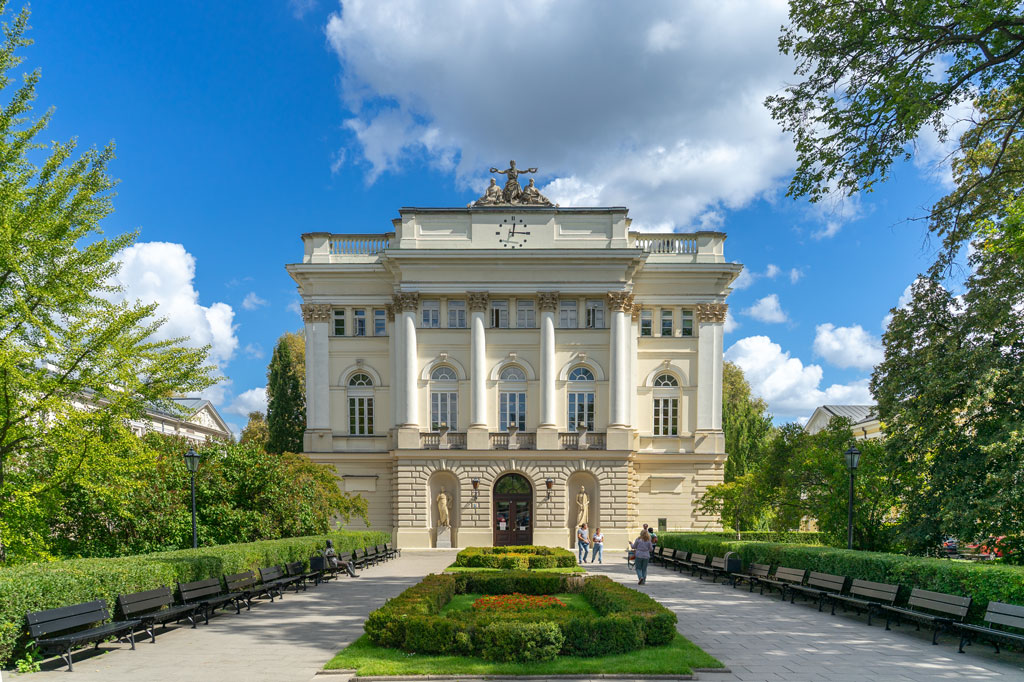
The walkway running behind the building leads to the Main School premises. Behind the imposing door is a staircase with cast-iron columns and railings. Henryk Sienkiewicz and Bolesław Prus used to grab hold of the handrail as they rushed to class. An olive tree can be found in front of the entrance to the Main School.
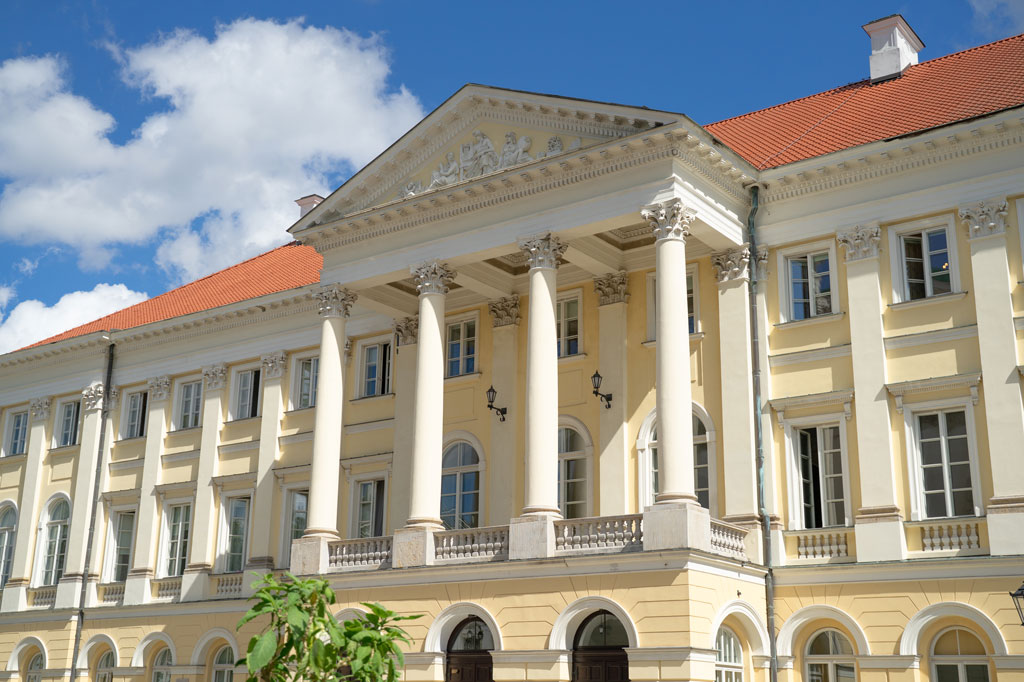
The Rector’s Office is located in the Kazimierzowski Palace, behind the Old Library. The palace is adorned with a monumental Corinthian portico and a bas-relief depicting Apollo with two muses. Long before it became part of the university, the palace housed the Knights’ School from 1765 to 1794, whose cadets included Tadeusz Kościuszko, a hero of the American War of Independence. The building itself, in a completely different Baroque style, was built in the 17th century as a summer residence for the rulers of the Vasa dynasty. It is named after King Jan Kazimierz, who was very fond of staying at the palace.
Academy of Fine Arts
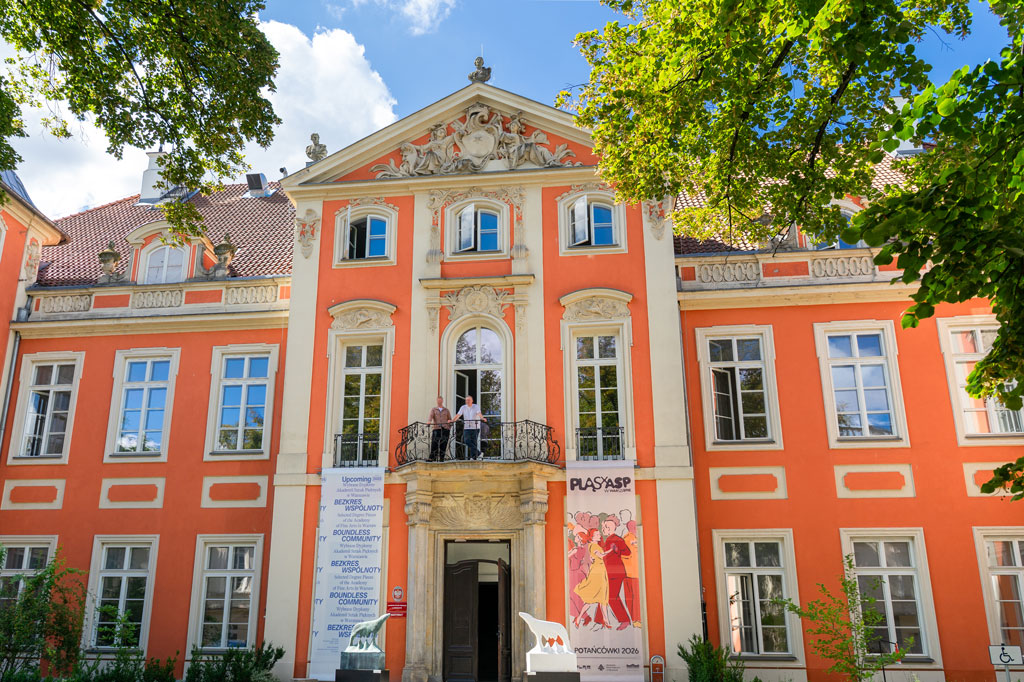
On the opposite side of Krakowskie Przedmieście, behind a gate featuring two stone eagles, lies the late Baroque Czapski Palace. This former aristocratic residence now houses the Academy of Fine Arts. Curious visitors can look in on the students at work in the graphic design studio. To do this, don’t enter through the gate, but turn left before it and head to the corner of Krakowskie Przedmieście and Traugutta Street. Through a large arched window on the ground floor, you can see a brick-vaulted room where students bustle around printing presses. This is the palace’s left wing, which houses the Faculty of Graphic Arts. On the right, on the other side of the gate, is the Faculty of Painting, which has no convenient vantage point to watch students at work. Even so, it is worth viewing completed works inside the palace. To do this, enter through the eagle-topped gate and follow the main walkway, passing seasonal sculpture exhibitions along the way.
At the end of the path is a palace that serves as the rectorate and Museum of the Academy of Fine Arts. The building’s exterior strikes visitors with a wealth of ornamentation typical of late Baroque architecture. The palace’s orange-rendered walls contrast with light-coloured cornices, lesenes, and window frames, creating a delicate decorative pattern that graces the main structure and its corner alcoves, which are crowned by fancifully shaped roofs. Art exhibitions are held in the palace.
Warsaw University of Technology
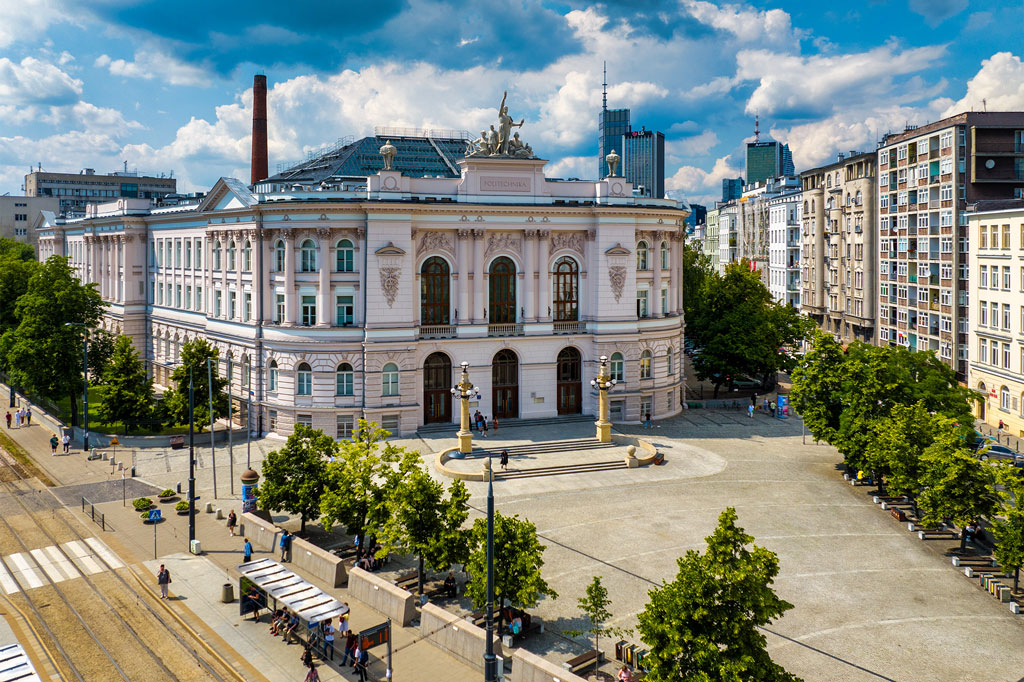
Warsaw’s most prestigious technical university has a campus located at Plac Politechniki. The imposing, Neo-Renaissance Main Building designed by Stefan Szyller catches the eye. The spirit of late 19th century architecture was for buildings to ‘speak’ to the observer, explaining their purpose and meaning. Let us then attempt to decode the messages embedded by the architect in the main building’s façade. The easiest to read are the construction dates set high on the projecting bays framing the central part of the façade (1899 and 1901). It may be more challenging and fun to try and guess the allegories of the University of Technology’s original faculties, depicted above the arches of the first-floor windows. The first from the left is the Faculty of Mining and Metallurgy (one of the figures is holding a hammer and chisel), the middle one with laboratory equipment (a retort) depicts the Faculty of Chemistry, and on the right are the Faculties of Engineering and Construction (a tower) and Mechanical Engineering (gear wheel). The Neo-Renaissance style evokes the Renaissance era, the ideas of humanism, and by extension, teaching and research.
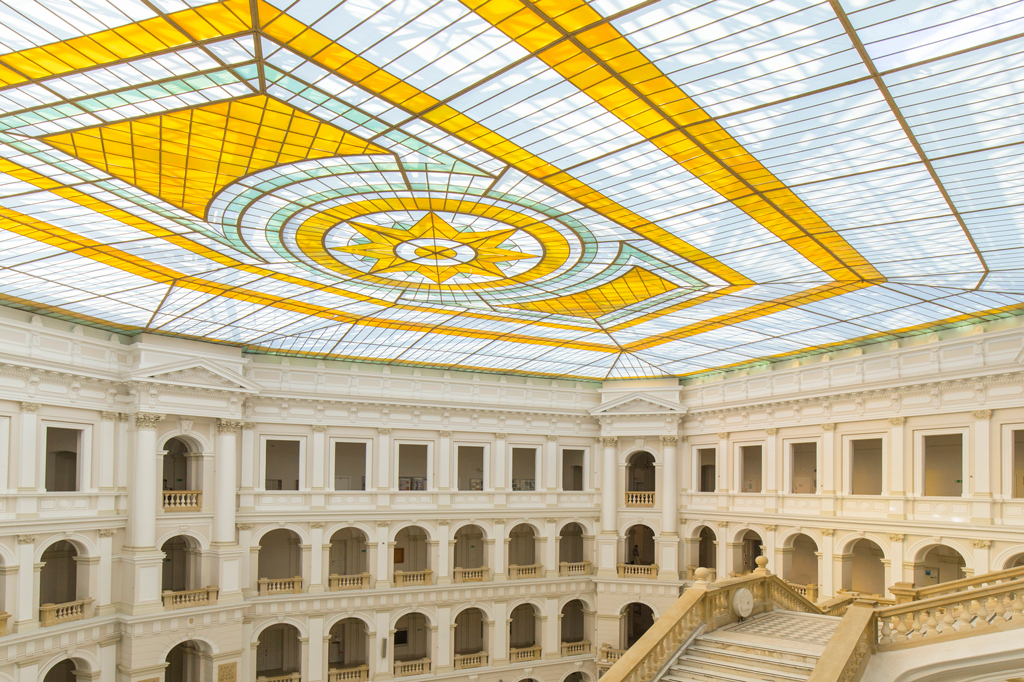
However, the greatest attraction of the university’s Main Building is hidden inside. After passing through the door, you are met by a spacious auditorium − an internal arcaded courtyard covered by a glass roof. Particularly eye-catching is the open staircase, which Szyller modelled on the one in the late-Renaissance castle in Baranów Sandomierski. The courtyard can be viewed from the ground floor and from three upper floors − making a stunning impression from every level.
Behind the Main Building is a small square with a fountain. Buildings representing diverse architectural styles were erected around it. On the western wall of the Faculty of Chemistry building on Noakowskiego Street, it is worth looking out for decorative reliefs in the shape of ancient Egyptian heads. Standing in the middle, the Physics Building is crowned with the dome of an astronomical observatory. Adjacent to the Faculty of Mechanical and Industrial Engineering stands the Old Boiler Room Building with its tall chimney, which once supplied energy to the entire campus. Further on, we find examples of more recent architecture: the modernist Chemical Technology Building from the interwar period, clad in grey brick, and the Mathematics Building from 2012, whose glass façades enable lectures to be observed from outside.
Warsaw School of Economics
The campus of the Warsaw University of Technology borders the park Pole Mokotowskie, on the southern side of which is the Warsaw School of Economics. The college’s distinctive buildings were designed before the Second World War by Jan Koszczyc-Witkiewicz. The Experimental Facilities and the Library were built before 1939, while the Main Building was completed in 1955 to a design by Stefan Putowski, who modernised the earlier plans.
The buildings form a unique and harmonious architectural ensemble − a blend of Art Deco ornamentation and the austere rhythm of modernist design. The buildings’ distinctive features include their crested corner rooflines and mosaics with a diamond motif beneath them. The façades reveal the divisions of the reinforced concrete frame structure, allowing for the installation of large windows. The place where Witkiewicz’s ‘architecture of light’ is most evident is the Parachute Hall in the Main Building. Its stepped glass roof can be seen from the outside, creating a striking spectacle at night. Inside, you can admire a spacious, sunlit courtyard surrounded by modernist galleries. It invites comparison with the Great Hall of the Warsaw University of Technology.

Warsaw University of Life Sciences
The Rector’s Office of the Warsaw University of Life Sciences is located in the former 18th century Rozkosz Palace. Its most famous resident was the writer and historian Julian Ursyn Niemcewicz, who hosted Juliusz Słowacki there in 1830. The university received the palace, along with the entire complex, in 1956. The Neo-Renaissance building stands adjacent to the understated architecture of Socialist Realist teaching buildings. Nearby the palace, look for the Niemcewicz Tree − a black walnut traditionally said to have been planted by the writer in 1822 from seeds gifted to him by US President George Washington. The historic grounds, featuring a terraced garden on the escarpment, are accompanied by an extensive new campus.

Chopin University of Music
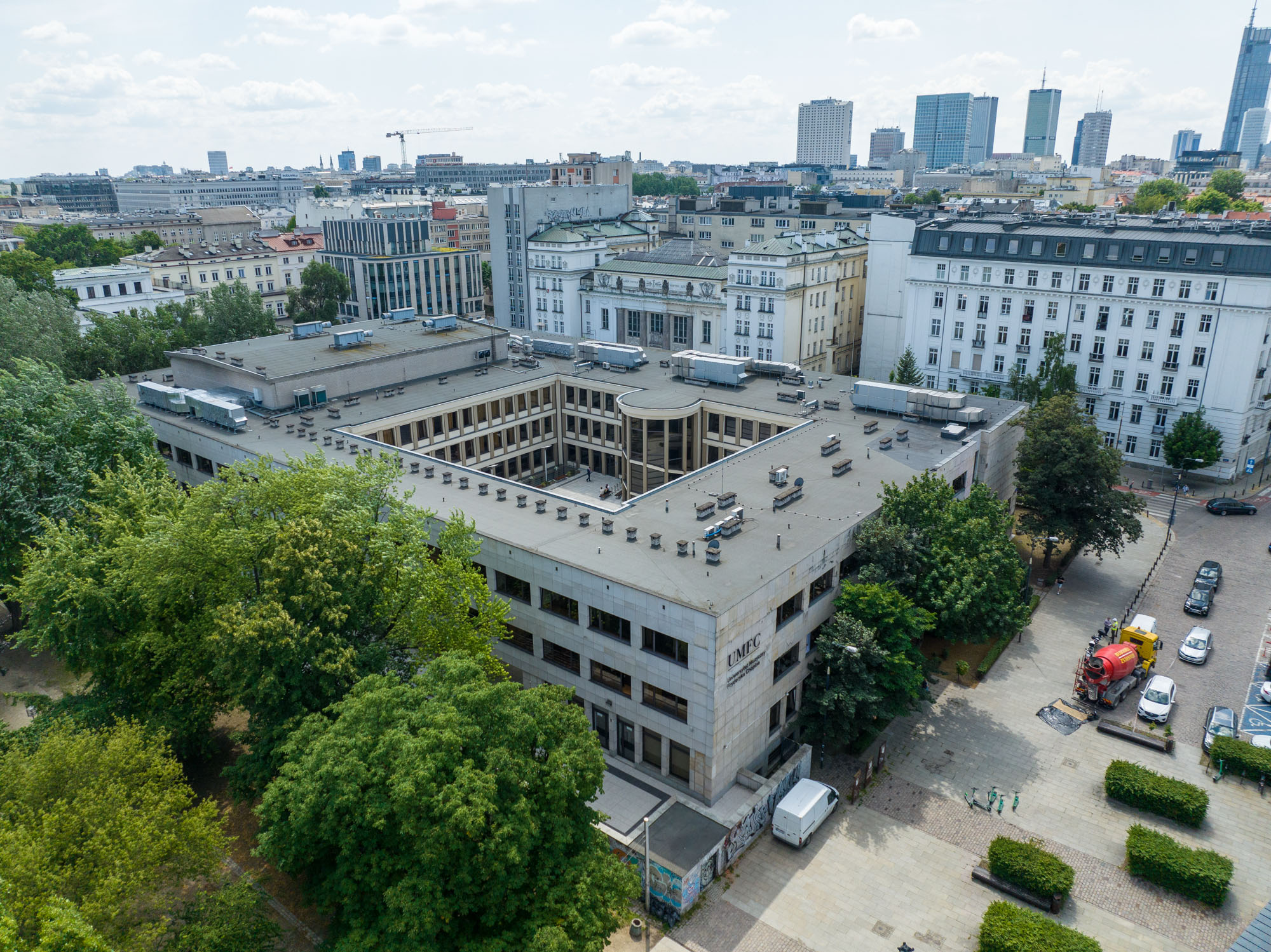
The Chopin University of Music is housed in an impressive example of modernist architecture on Okólnik Street. Built between 1959 and 1966 to a design by Witold Benedek, Stanisław Niewiadomski and Władysław Strumiłło, its entrance is set in a narrow gap under a massive, windowless, sandstone-clad block, in contrast to the rest of the building’s heavily glazed walls. The building surrounds an internal courtyard that provides students with a secluded haven. The courtyard eastern side has an open ground-floor area overlooking the adjacent park.
Cardinal Stefan Wyszyński University in Warsaw
Far from downtown Warsaw, in Bielany Forest, Camaldolese monastery buildings were built in the 17th century. They included a late Baroque church, completed in the 18th century, and small hermitages for the Camaldolese monks, who lived in seclusion. The Academy of Catholic Theology moved into the former monastery buildings in 1954. Walking among the preserved hermitages is an extraordinary experience. Stanisław Staszic, a distinguished scholar who valued peace and modesty, is laid to rest here. His grave is located on the east side of the church.
Historic university campuses usually only form part of the grounds and facilities they manage. It is therefore also worth visiting the modern campuses of the University of Warsaw in Powiśle, Ochota and Służewiec, of the Warsaw University of Technology along Aleja Armii Ludowej, and of the Academy of Fine Arts on Wybrzeże Kościuszkowskie. The facilities built by universities are often extraordinary works of architecture, perfectly integrated into the greenery, thereby offering the pleasure of walk along with that of making cultural discoveries.

For more tips on how to visit Warsaw sign up for our newsletter and stay up to date!
* By clicking the ‘Subscribe’ button you consent to receiving the newsletter from us and accept the Regulations of the ‘Newsletter’ service. We will process your e-mail address for the purpose of sending you the newsletter. The administrator of your personal data is the Warsaw Tourism Office. More information on the privacy policy and cookies policy and clause concerning the processing of personal data.