Go To WarsawOver its 70 years, the Palace of Culture and Science has become one of Warsaw’s most recognisable symbols
Over its 70 years, the Palace of Culture and Science
has become one of Warsaw’s most recognisable symbols
Author: Jerzy S. Majewski – journalist, columnist, Varsavianist and art historian
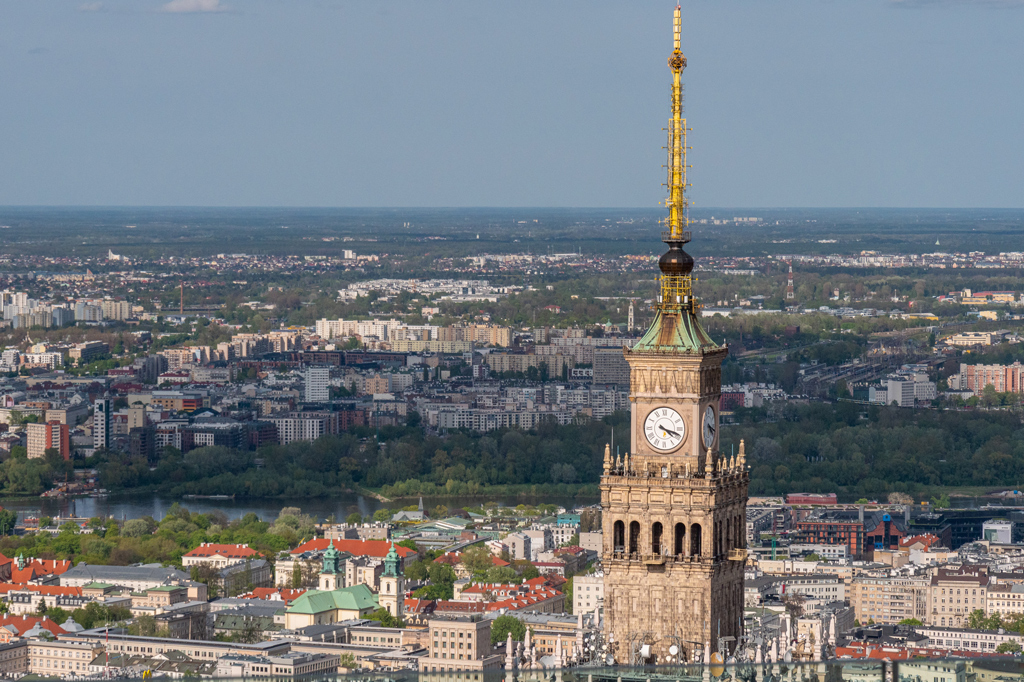
It is one of the capital’s most visited landmarks. In summer, the grand main hall is almost always lined with a long queue of people taking the lift to the popular viewing terrace, perched 114 metres above the ground. From here, a sweeping panorama of the entire city unfolds.
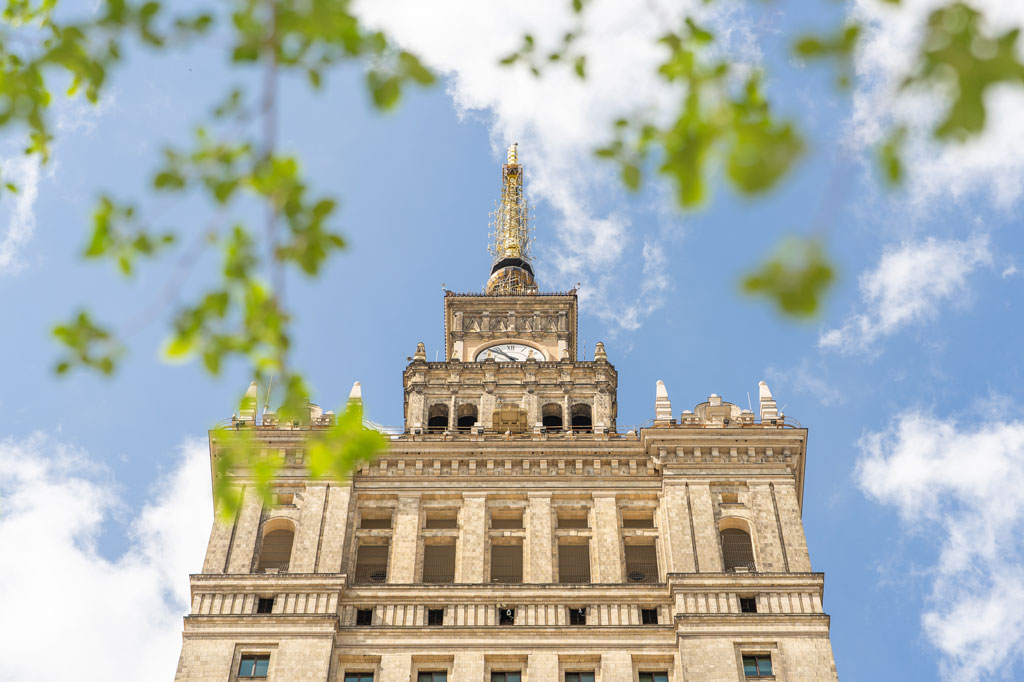
The Palace itself rises far higher. From the ground to the tip of its spire, it measures 230 metres and 68 centimetres. Its usable floor space covers 123,000 m² – more than 12 hectares. Inside are nearly 3,300 rooms of varying sizes. Construction involved 40 million bricks, 80,000 m³ of concrete and 28,000 m² of marble. The building’s framework is a steel structural skeleton weighing 25,000 tonnes.
Pałac Kultury i Nauki, fot. Łukasz Kopeć
Today, on the 70th anniversary of the Palace’s opening, the area around it is undergoing a dramatic transformation. The vast Parade Square – famously described by writer Leopold Tyrmand as the largest square in Europe – has been reshaped on a human scale and given a new name: Central Square. The palace was officially opened on 21 July 1955, in a grand ceremony timed to coincide with the 5th World Festival of Youth and Students. The festival had the opposite effect to what the communist authorities intended. Instead of strengthening the regime, it helped lift the Iron Curtain that separated Poland from the West. Encounters with joyful, colourful young people from abroad left a powerful impression on the youth of socialist‑realist Warsaw. After the festival, nothing was quite the same. An era of jazz, modernity and abstraction was beginning. Socialist realism was on the way out. The paradox is that the Palace of Culture and Science, built as the pinnacle of socialist‑realist architecture in Poland, was already a relic of a fading era at the moment of its birth.
Pałac Kultury i Nauki, fot. Joanna Wiśniewska
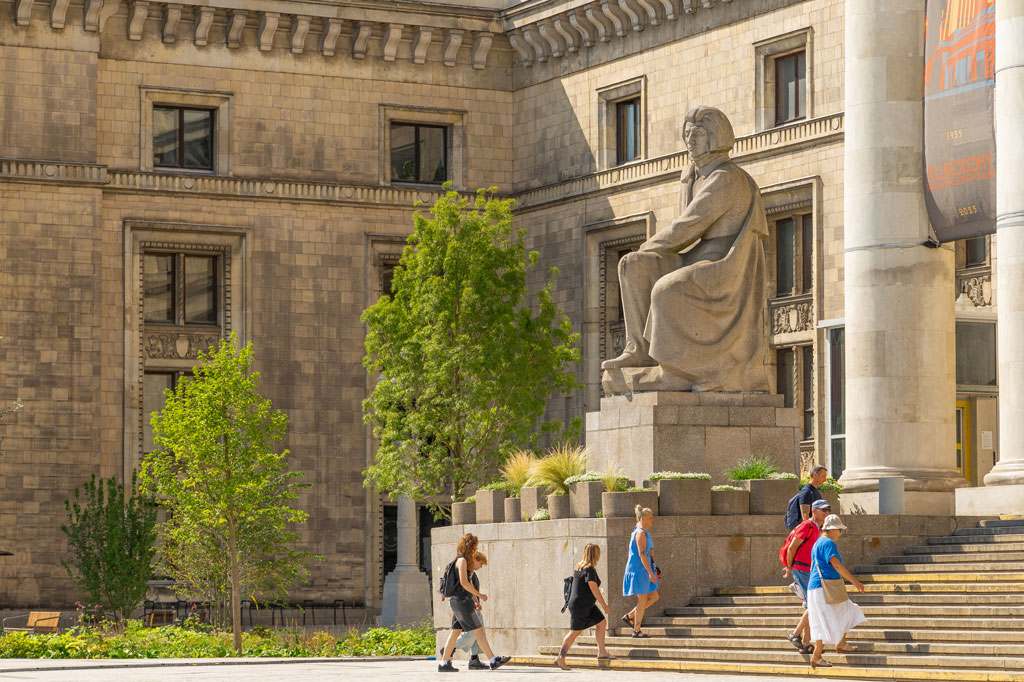
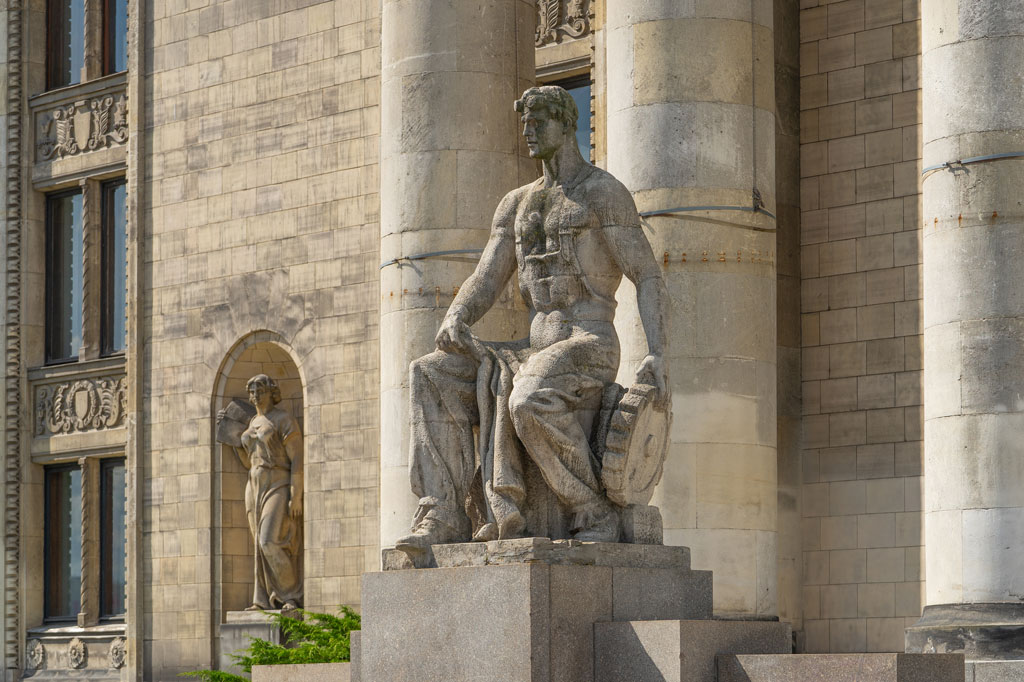
That era ended soon after with the death of Bolesław Bierut on 12 March 1956 and the political changes of the Polish October later that year. There is another paradox. While Poles saw the tower’s architecture as Soviet, many in the USSR did not. To them, it seemed like the fulfilment of long‑held dreams of American skyscrapers. In scale, height, modern construction methods and the surrounding layout, the Palace was meant to compete with them. Yet it also incorporated Polish motifs: its slender proportions were inspired by the town halls of Gdańsk and Chełmno, while the attics crowning the low podium and side wings echoed Polish Renaissance designs. Around the base stand 30 socialist‑realist statues, 28 brought from the USSR and two, of Nicolaus Copernicus and Adam Mickiewicz, created by leading Polish sculptors and placed before the main entrance.
Pałac Kultury i Nauki, fot. Maciej Deperas
The idea of building a skyscraper for Warsaw was first proposed by Stalin in 1949. The final agreement was signed on 5 April 1952. It was designed by the Moscow architect Lev Rudnev and a team of Soviet designers. During their research trip they visited towns such as Kazimierz Dolny, Sandomierz and Gdańsk. Impressions from that journey found their way into the Palace’s architecture.
For Stalin, the construction of the Warsaw tower was a priority. The concept design was produced at breakneck speed, and the final height of the building was decided by Poles in the presence of the Soviet architects. The first shovels, or in this case, diggers, broke ground on 2 May 1952.
Pałac Kultury i Nauki, fot. Maciej Deperas
The work was carried out by engineers and labourers brought in from the USSR. A relic of their presence still stands today: a settlement of wooden houses in the Jelonki district of Warsaw. The most important element of the structure, its steel skeleton, was brought from a steelworks in Dnipropetrovsk (today Dnipro, in Ukraine, now under Russian bombardment).
When it was completed, the Palace dominated Warsaw’s skyline, standing alone and visible from miles away. Today, it is just one among dozens of towers, no longer the tallest, but still standing out from the bland uniformity of glass‑clad commercial high‑rises.
Unlike them, the Palace of Culture and Science is a public building, home to a hive of cultural and educational institutions: universities, four theatres, the Kinoteka multiplex cinema, museums, and the Palace of Youth, which has shaped generations of Warsaw’s children.
The Congress Hall was almost a separate part of the building. Before its long‑running renovation, it hosted countless concerts, congresses and cultural events. In the PRL era, the Palace was also home to legendary dining and entertainment venues, now gone, including the Russian restaurant Troika, and the Kongresowa restaurant with its dance floor and striptease shows. In the 1960s, this was the beating heart of Warsaw’s nightlife.
Pałac Kultury i Nauki, fot. Maciej Deperas
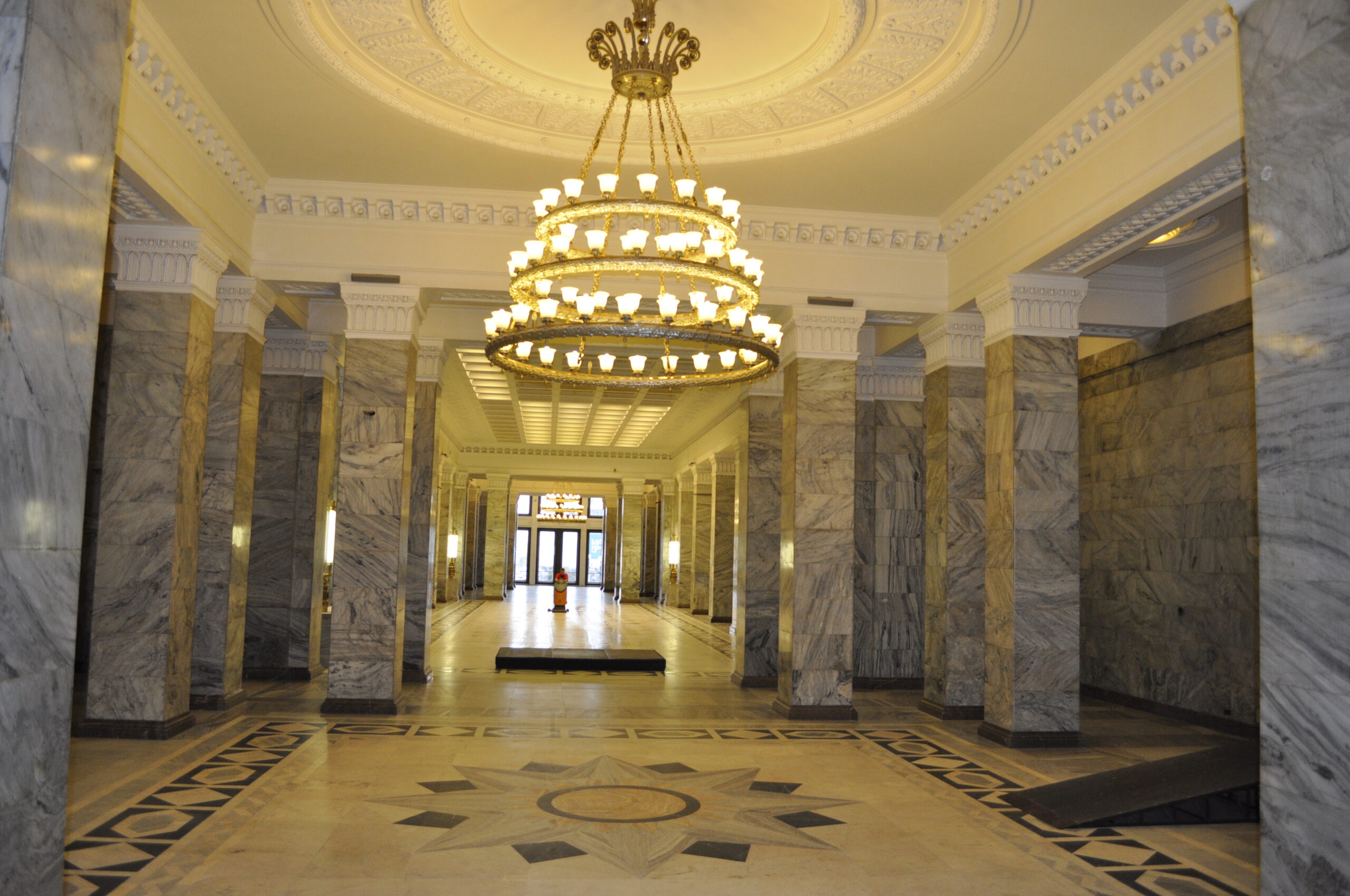
Both the entrance hall and the palace’s state rooms surprise visitors with their scale, opulence and quality of finish. As you walk through them, look closely at the sheer number of individually designed details. The building is, in itself, a museum of style.
Among the most striking spaces is the Marble Hall (to the left of the Main Hall), a vast 1,150‑square‑metre chamber adorned with marble and impressive chandeliers. Other notable rooms include the Trojka Hall, the Ratuszowa Hall, and, one floor above, the Władysław Broniewski Hall, decorated with allegorical murals.
Equally imposing are the two grand marble staircases, comparable in scale to those in baroque royal palaces. Their socialist‑realist compositions were, according to a popular anecdote, once mistaken by rural visitors for depictions of saints. These are just a few examples of the palace’s grand interiors.
Pałac Kultury i Nauki, fot. Weronika Kośniewska
Out of the countless events hosted at the Palace of Culture and Science – festivals, concerts, congresses, conferences, film shoots, theatre premieres and exhibitions – one in particular became a milestone in the history of the People’s Republic of Poland.
On 13 April 1967, The Rolling Stones performed in the Congress Hall. “We had never seen anything like it. They were aliens, playing rock and roll, four hundred years ahead of us!” wrote one contemporary account. The concert made such an impact that it is remembered as one of the most important music events in Poland before 1989. Outside the Congress Hall, while the Stones played inside, clashes broke out between young fans and the militia, who for the first time tested the effectiveness of water cannon.
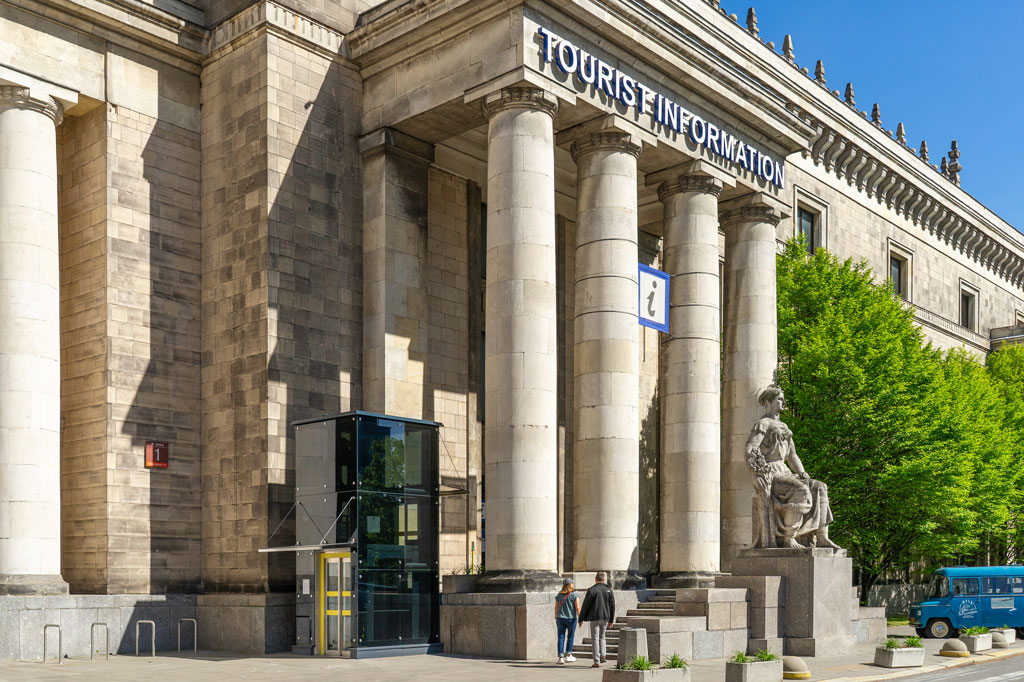
Punkt Warszawskiej Informacji Turystycznej w Pałacu Kultury i Nauki, fot. Maciej Deperas